






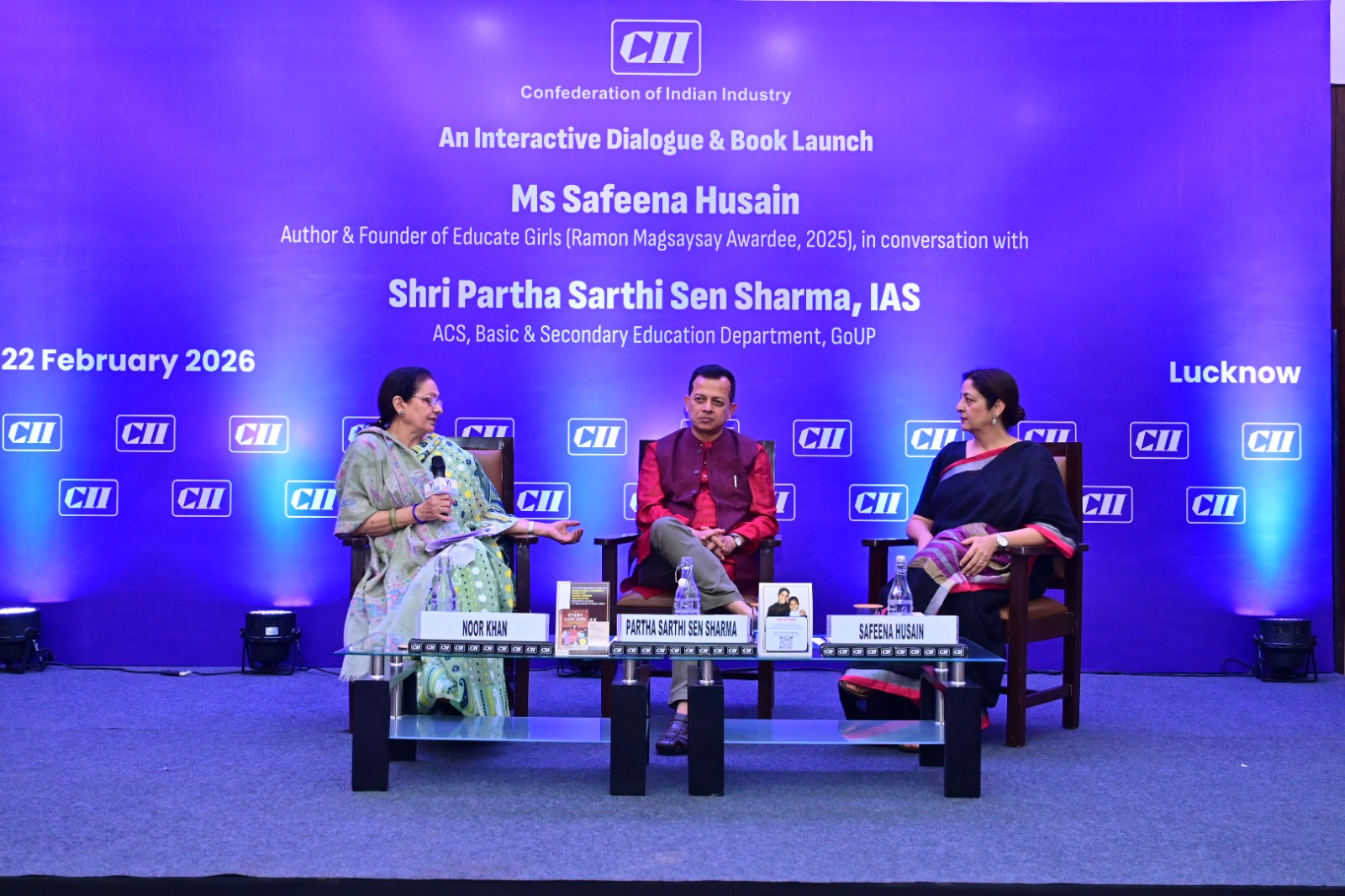
At a powerful gathering hosted by the Confederation of Indian Industry (CII), educators, policymakers, and industry leaders came together to celebrate the launch of Every Last Girl: A Journey to Educate India’s Forgotten Daughters – and the extraordinary story behind it.
The book was unveiled by Safeena Husain, Founder of Educate Girls, in conversation with Partha Sarthi Sen Sharma, IAS, Additional Chief Secretary, Government of Uttar Pradesh, and moderated by Dr. Noor Khan, Educationist and Trustee of Lucknow Bioscope Sanatkada Trust. The event brought together data, dialogue and deeply human stories that illuminate the changing landscape of girls’ education in India.
A Journey from Rajasthan to 30,000 Villages
What began in 2007 in a handful of villages in Rajasthan has grown into a grassroots movement through more than 55,000 volunteers, Team Balika spanning over 30,000 villages, helping more than two million out-of-school girls return to learning. In 2025, Educate Girls became the first Indian organisation to receive the prestigious Ramon Magsaysay Award – marking a historic milestone not only for the organisation but for the movement for girls’ education in India.
Stories Behind the Statistics
Reflecting on the award, Ms Husain said, “It is such an incredible moment that Educate Girls became the first Indian organisation to receive the Ramon Magsaysay Award. It was a recognition that we felt was important to use to tell these stories. It is our responsibility to put out our voice and celebrate the progress that has been made in girls’ education. We are deeply thankful to the Government for the incredible work that has focused on girls’ education to reach every last girl. As we look ahead, our vision is to reach 10 million learners by 2035. If girls do not complete their 10th, they are largely excluded from the economic mainstream. We need to work on that.”
Dr. Khan underscored the urgency of continued action, “Enrollment has gone up, but out-of-school girls still remain, and that is the gap that Educate Girls addresses.”
Placing the conversation in a broader national context, Mr Sharma noted, “In the last 50 years as per the macroscale data the status of education has changed. Earlier, the gender parity index was around 60 which has now reached 100 percent gender parity index. It is a remarkable change. Although it varies from district to district. The macroscale data however does not show the stories.” He added, “It is important to listen to stories, build on the stories and use those stories to make stories.”
A Call to the Future
Every Last Girl: A Journey to Educate India’s Forgotten Daughter is more than a book – it is a testament to what happens when communities are mobilised, local leadership is built and girls are placed at the centre of progress. The launch at CII highlighted a powerful truth: while macro data shows remarkable gains in gender parity, the lived experiences of girls still out of school remind us that the work is far from complete. As India looks toward the future, the message from the evening was clear – educating every last girl is not only a moral imperative, but an economic and national one.