






Among the prehistoric creatures that have baffled paleontologists, the Tanystropheus, whose elongated neck made it seem biologically impossible at first glance due to its incredible length relative to the rest of the creature’s body, was probably the most confusing. This debate, which started soon after the identification of the animal’s fossils in the nineteenth century, centered on the question of whether it lived on land or in water, but the available information was not sufficient enough for scientists to draw any definitive conclusions, as many fossils of its skull had flattened out over the ages.
The issue was not the lack of curiosity, since it was exactly the creature’s peculiar anatomy that had sparked interest in studying it for decades. The vertebrae in the creature’s neck were incredibly elongated, which made it look very unusual compared to any living animal. However, the creature’s anatomical oddities also made studying it difficult, as it was based on partial and deformed fossils. As a Field Museum news release reports, scientists used computed tomography to visualize the inner structure of the creature’s skull, which was concealed beneath the fossil’s surface.


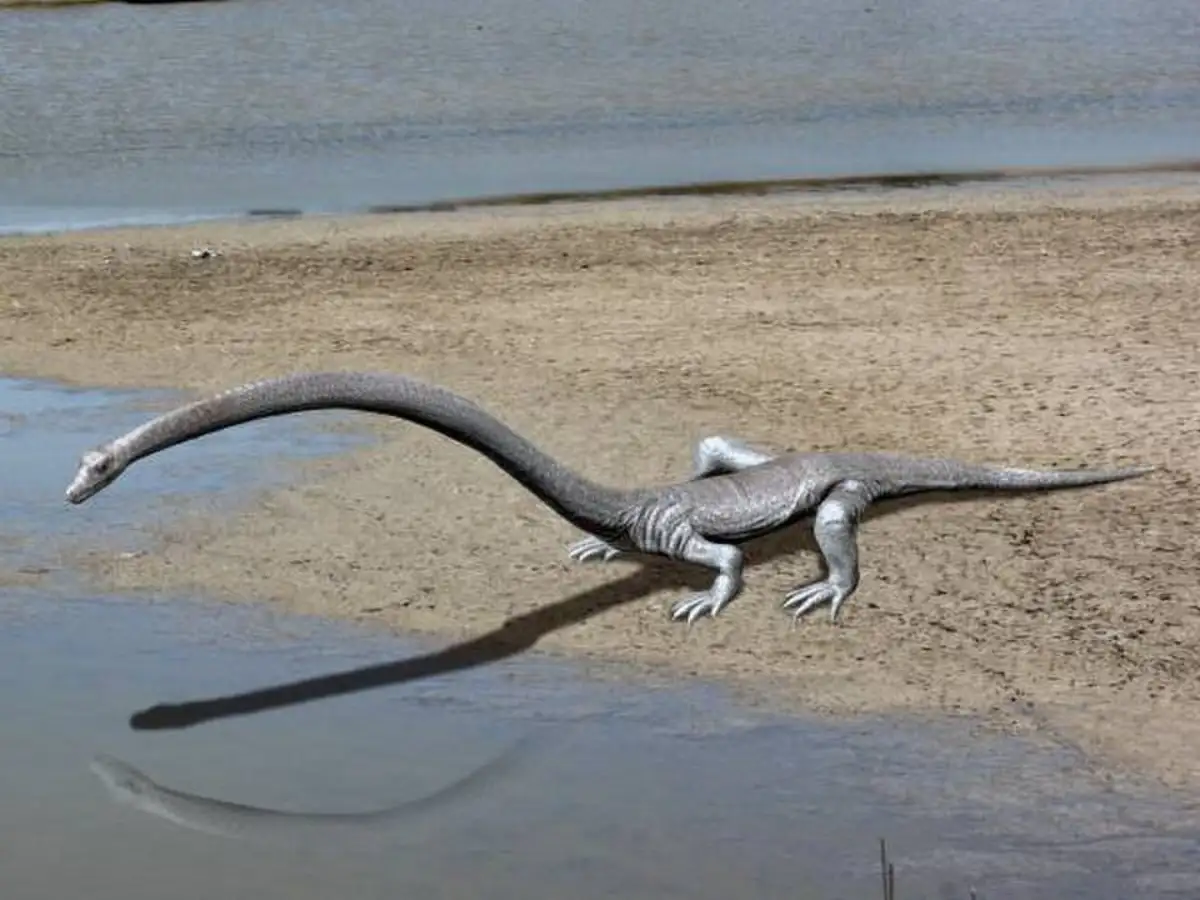
Conceptual design of the Tanystropheus | Image Credit: Wikimedia Commons
The skull evidence began pointing much more strongly toward marine hunting
As scientists gained a clearer idea of what Tanystropheus’ head looked like through CT scans, it became increasingly hard to believe the previous theory that placed the species primarily on land. “It’s really about the shape of the skull,” according to the study in Current Biology. “That shape was much more reminiscent of an aquatic ambush predator rather than terrestrial reptiles that walk around on the ground,” explains the report. This is extremely important because skull shape is central to discussions of feeding habits.
It was established that the large Tanystropheus had sharp, interlocking teeth, along with features on its head indicating it caught slippery animals such as fish. The long neck was also better explained in the context of shallow-marine environments because it would not need to move to capture prey quickly at a distance. As reported by Science Magazine, it was suggested that the creature hunted like an ambush hunter in marine environments rather than lumbering around on dry land with such an awkwardly long neck. This shift in perspective changed more than just where people thought the animal lived: it altered their entire conception of the creature’s behavior and lifestyle. The bizarre reptile was no longer seen as an awkward land creature but rather as one that fit its marine environment better.