A new exhibition of works by Francis Newton Souza invites viewers into the restless, often unsettling world of one of India’s most provocative modern artists—a man who refused to paint for comfort, approval, or convention.
Drawn from the noted Harish Khullar Family Collection, the show does more than assemble paintings; it traces the arc of an artist who helped redefine Indian art in the years following Independence. As a founding member of the Progressive Artists’ Group, Souza stood at the forefront of a movement that broke decisively from colonial academic traditions, forging instead a bold, self-assured modernism.
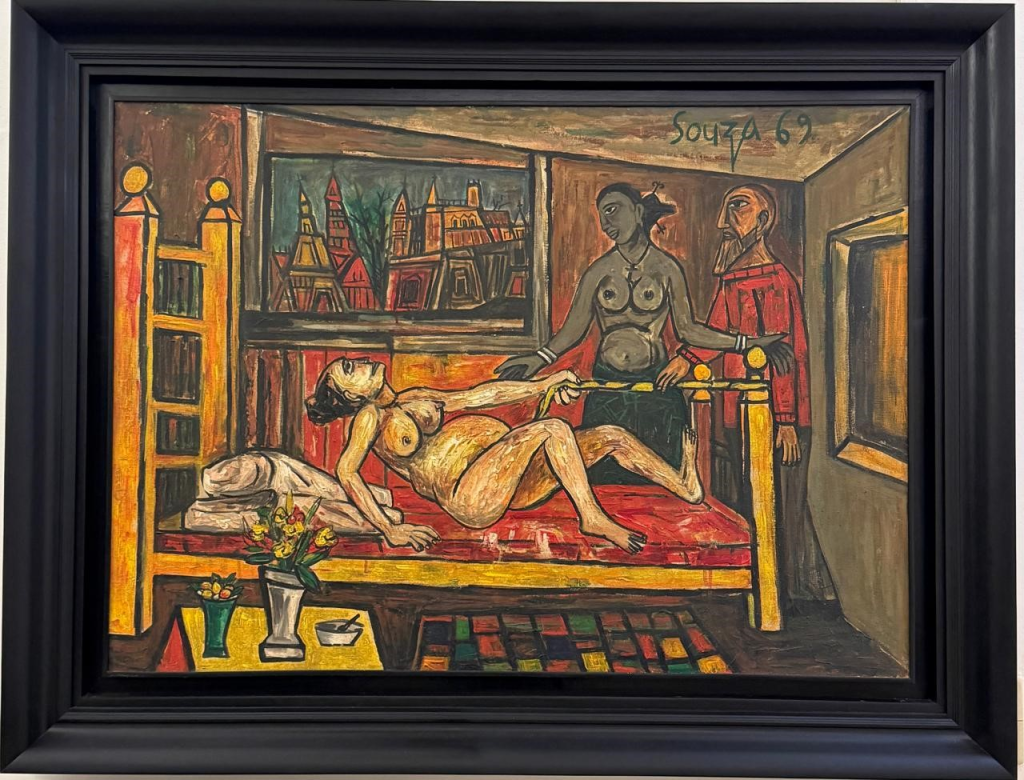
At the heart of the exhibition is a striking 1962 painting that captures Souza at his most unflinching. Set within a cramped, almost claustrophobic interior, the work presents a nude female figure sprawled across a bed, her body rendered in harsh, angular strokes. Two figures—one male, one female—stand beside her, their faces mask-like, their expressions ambiguous, almost accusatory. The room itself feels charged: a window opens onto a jagged cityscape, furniture sits in uneasy symmetry, and the palette—rust reds, ochres, and bruised greens—intensifies the sense of tension.
It is a scene that resists easy interpretation. There is intimacy, but also detachment; vulnerability, yet a strange theatricality. Souza’s line is deliberately crude, almost abrasive, stripping away any illusion of softness. The nude is not idealised—she is exposed, physical, real. The onlookers, meanwhile, appear complicit, perhaps even voyeuristic. One is reminded of Souza’s lifelong preoccupation with the human condition—its desires, hypocrisies, and contradictions—laid bare without apology.
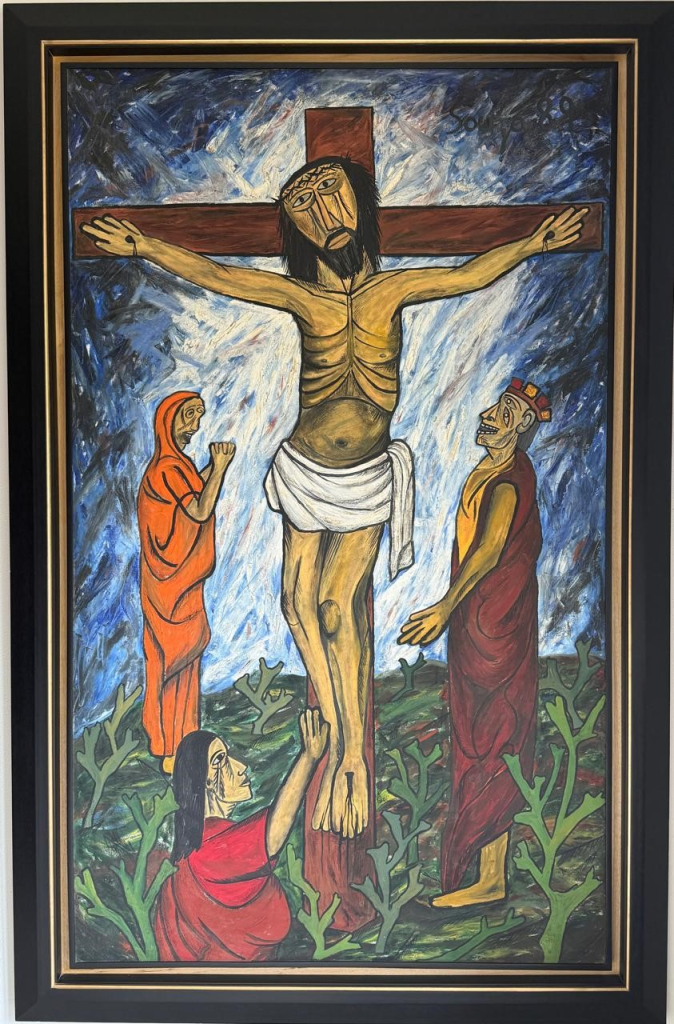
This painting, like much of Souza’s work, draws from his early exposure to Catholic imagery, yet subverts it entirely. The composition faintly echoes religious tableaux, but replaces sanctity with raw corporeality. It is precisely this tension—between the sacred and the profane—that defines Souza’s visual language.
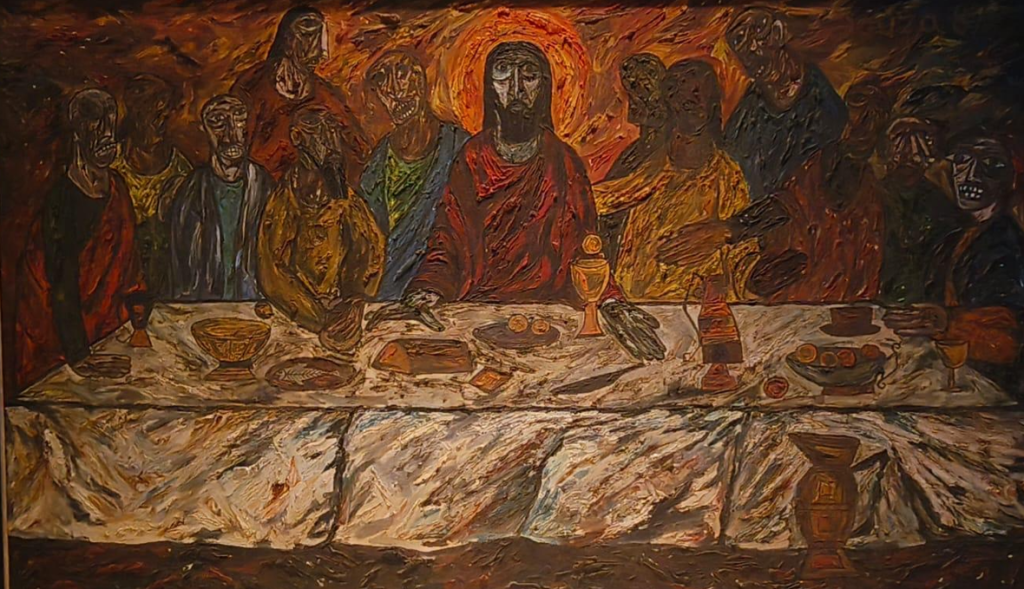
One of the most arresting works in the exhibition is Souza’s reinterpretation of the Last Supper, where the familiar Biblical scene is stripped of serenity and recast in his characteristically abrasive visual language. Christ, haloed but austere, sits at the centre, surrounded not by reverent disciples but by figures rendered as distorted, almost spectral presences—their faces gaunt, their expressions uneasy, even complicit. The table, laden with bread, fish, and wine, anchors the composition, yet offers little sense of communion; instead, it becomes a stage for tension and psychological unease.
Souza replaces the sacred calm traditionally associated with the scene with something far more unsettling—an exploration of betrayal, doubt, and the frailty of faith. Thick, gestural brushwork and a palette dominated by burnt reds, ochres, and shadowed blacks heighten the drama, turning what is conventionally a moment of spiritual unity into a deeply human, fractured encounter.
Elsewhere in the exhibition, recurring themes emerge with equal force. Churches, priests, distorted heads, and fragmented bodies populate his canvases, each rendered with an urgency that feels almost confrontational. Influences from European modernism—Cubism, Expressionism—are evident, but never dominant. Souza absorbed these vocabularies only to bend them to his own purpose.
His life, too, informs the work. A political dissenter, an émigré, and a relentless provocateur, Souza painted with the intensity of someone unwilling to compromise. His subjects—religion, sexuality, power—remain as relevant today as they were decades ago.
What makes this exhibition particularly compelling is its refusal to soften Souza’s edges. These are not decorative works; they are demanding, often uncomfortable, and deeply human. The 1962 canvas stands as a reminder of that uncompromising vision—an image that lingers, unsettles, and insists on being reckoned with.
In an age increasingly drawn to polished surfaces and safe narratives, Souza’s work cuts through with rare honesty. It does not seek approval. It asks, instead, to be confronted.