





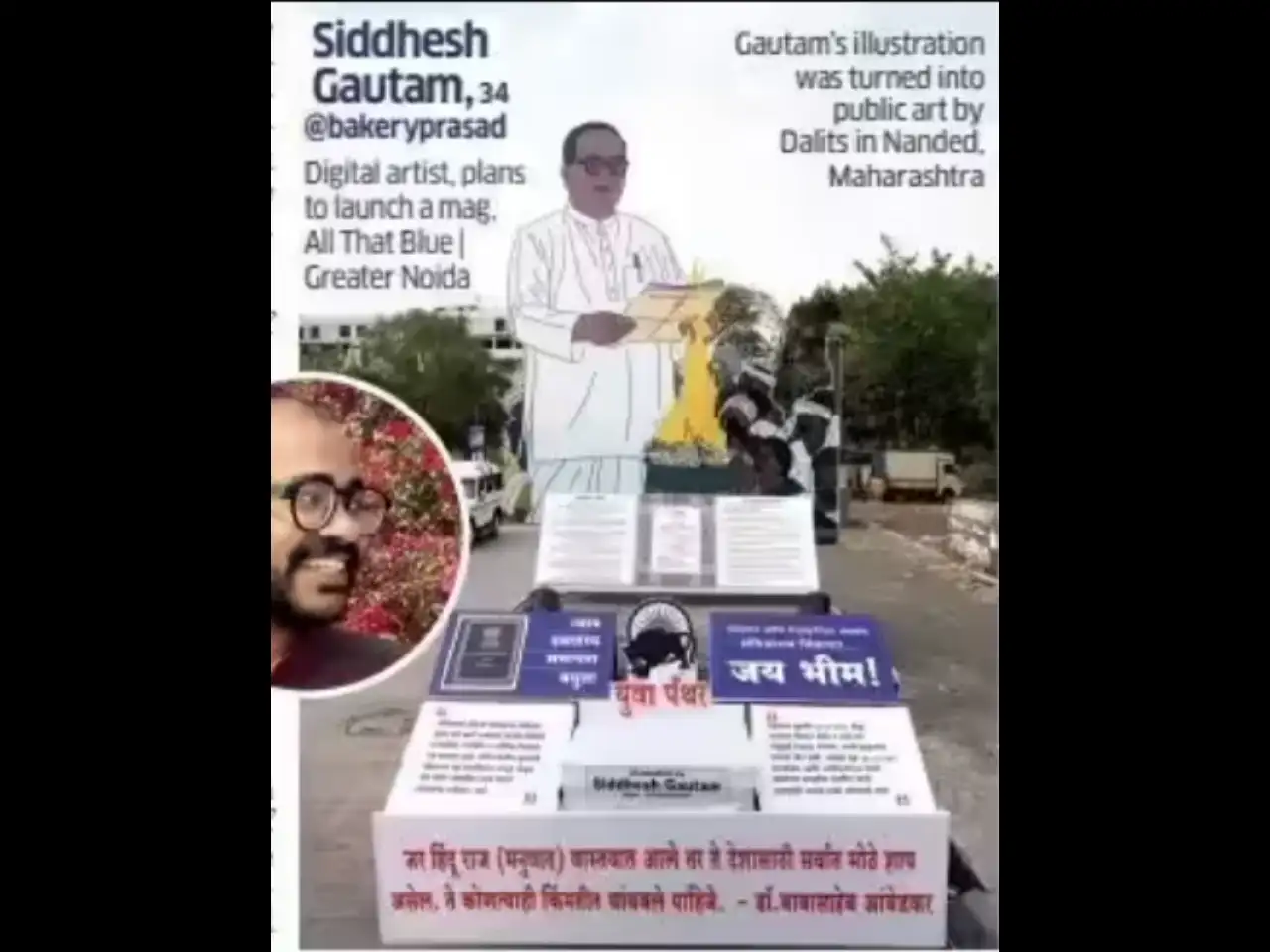
This is my gallery,” says artist Siddhesh Gautam. It is his 80,000-strong Instagram account, @bakeryprasad. The quirky name came accidentally—he first called it @bakeryproducts, but after people began tagging him in actual cakes, @bakeryprasad was born. For over a decade, Gautam has used Instagram as a showcase. “For me, social media is the underground media of our time—at least it started out like that,” he says. His “gallery” is awash in a deep shade of blue of BR Ambedkar holding the Panchsheel flag, of Ramabai with raised fist, of Mahatma Phule turning into a stairway for children to ascend.
Gautam says the medium remains largely uncensored. What drew him in was not just visibility but accessibility. “Producing art is expensive and to showcase it, you need patrons. But thanks to social media, with an iPad and Procreate app, I have managed to create hundreds of art works.” His work has evolved—from responding to national politics to anticaste art, a shift that came around 2021, after reading Ambedkar’s Annihilation of Caste. For Gautam, it is also a way around the exclusionary nature of the art world. “Virtual media is not just a new medium for galleries to play with, but new galleries themselves.
Also Read: Art is a lot of work: Behind every painting that changes hands lies invisible labour
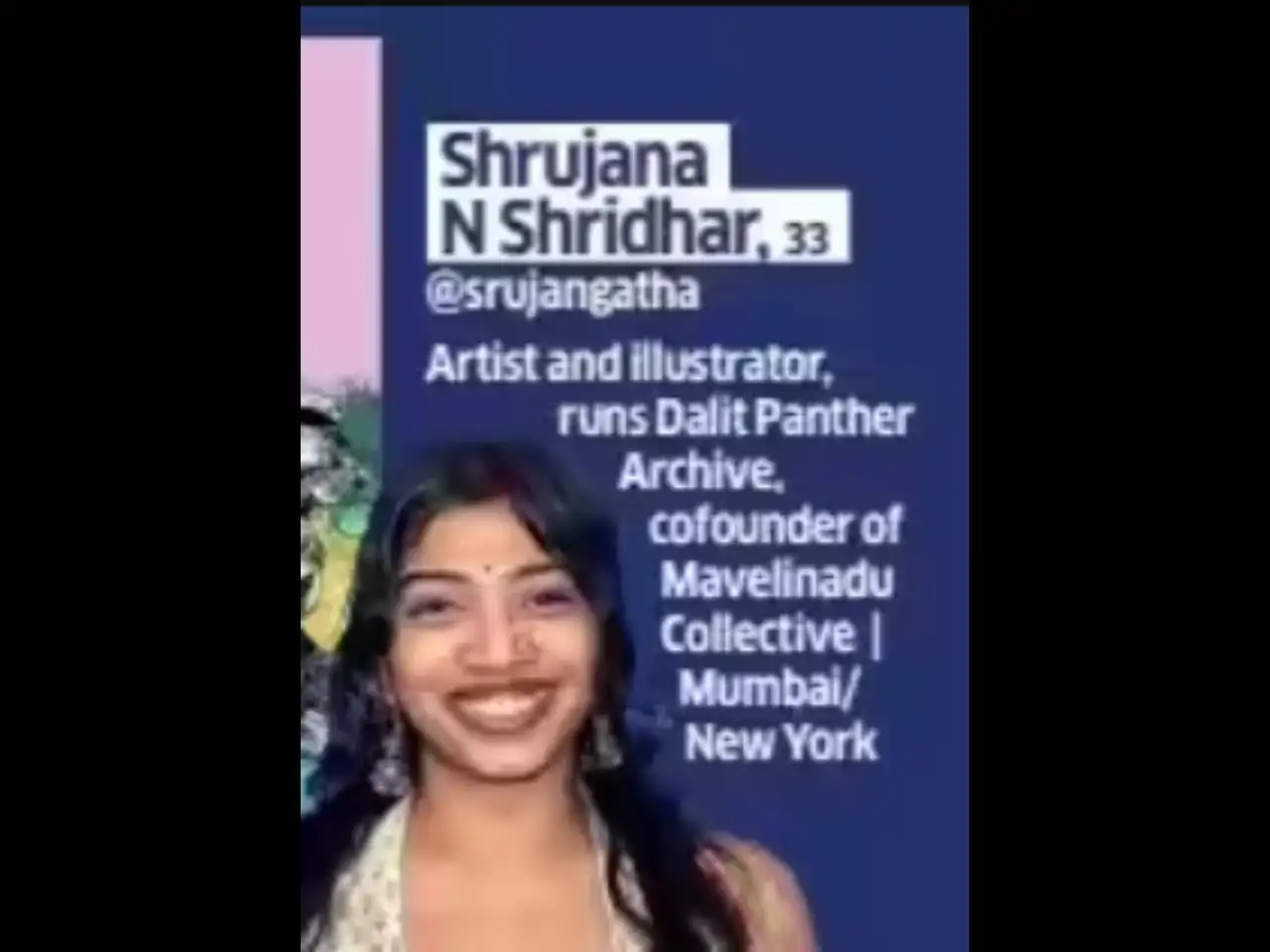
It’s a sentiment shaping Dalit and Bahujan expressions online as artists post work attempting to debrahminise India’s visual artscape. Priyanka Paul of @artwhoring posts a sci-fi image of Ambedkar, commissioned for a book cover, and frames Savitribai and Jotirao Phule in a heart-shaped Valentine’s greeting. Rahee Punyashloka of @artedkar imagines Rohith Vemula as an astronaut. Artist Shrujana N Shridhar draws Babasaheb reading on a bench in New York’s Central Park. Visual artists Jay Sagathia and Vineet Gedam remember Phoolan Devi, while Mumbaibased illustrator Bao of @thebigfatbao releases “The Anti-caste Calendar” every year.

This Dalit assertion on Instagram goes beyond the image as the artists give detailed captions—sometimes personal, sometimes educational. Some honour food memories while others recount caste discrimination, revisit anti-caste struggles and spotlight unsung heroes. Young Dalit artists frequently use metaphors and symbols borrowed from Dalit history.
QUESTION THE VISUAL LANGUAGE
Mumbai-based illustrator Paul, 27, who makes a lot of zines and writes prose and poetry, has been on the internet since she was a teenager. “I wanted to build a space where people like me could find a sense of belonging and understanding.” She says savarna cultural production is boring and hinges on the same old middle-class tropes such as parlour aunties and domestic workers taking leave. “This cultural production assumes that everyone lives life in these same contexts. I want to show that a world built on exploitation is not the norm, because it isn’t.”
Bao too says: “We need to question the hegemonic visual language of India. Om, swastika and upper-caste imagery become the default definition of ‘Indian’, while minorities and marginalised communities are erased. At the same time, Adivasi art forms like Warli are appropriated and commercialised without acknowledging the communities they come from.”
For years, Bao says, Indian art relied on imagery that never resonated with her. Gautam agrees. One of his artistic concerns is reshaping how Indian figures and histories are depicted visually, especially in relation to caste and colourism. “In India, even our historical imagery is sanitised and upper caste-coded. Savitribai and Phoolan have been shown as fair with pink cheeks. We need new ways of telling stories.”
Shridhar, who has done her master’s in fine arts from Parsons School of Design, New York, is working on a series called Educate. It is the first of a three-part body of work: Educate, Agitate, Organise. “Through Educate, I’ve been exploring what moves, inspires and hurts Dalit students, and what motivates them to continue pursuing knowledge—not only through institutional pedagogy, but as a larger political and emotional act.” Her series of paintings, “In Lieu of Mukta Salve”, is about Dalit women in academia.
She says, “These works also act as an anti-reference to artists like Raja Ravi Varma, who has essentially used upper caste women as his muse and painted them as literal goddesses. As scholars like Shailaja Paik and Christina Dhanuja have written, savarna women are afforded womanhood and dignity in ways Dalit women often are not.” Shridhar wants to reimagine what it means for Dalit women in academia to simply exist as human beings before carrying the enormous burden of scholarship, research and survival. “I’m also interested in how respectability politics shapes the imagery of Dalit women’s bodies and how rest itself can become a political act.”
Also Read: Breaking the white wall: How contemporary art galleries are evolving beyond the white cube
One part of her project is on water as a site of resistance, memory and caste violence. It is the focus of her well-known work Water and Caste, inspired by the Mahad Satyagraha.
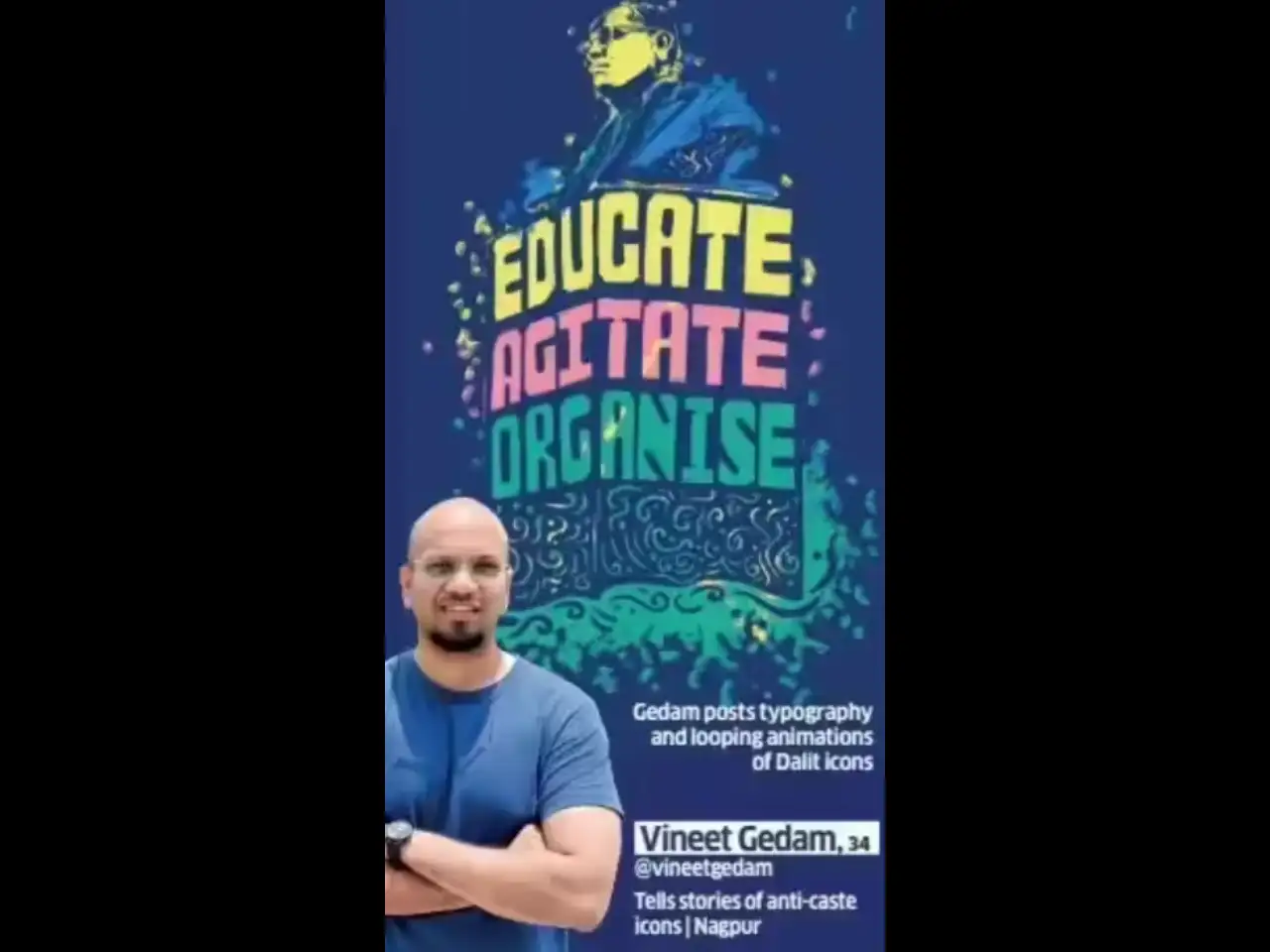
Other artists mine personal memories. Graphic designer Vineet Gedam, who posts typography and looping animations of Dalit icons, recently wrote about lambya rotya, a paper-thin roti that has a long history in the Dalit communities in Nagpur. He wrote: “Every time someone talks about Nagpur’s local food, you’ll only hear of either Saoji food, orange burfi, or tarri poha, none of which I, as someone who grew up in Nagpur, can relate to liking or eating at home, or even at family gatherings…. What I avoided talking about was how lambya rotya and our mutton curry were the foods most cherished at home. I learnt much later these foods were specific to our community and caste.” He mentions how foods from Dalit communities are now making it to the mainstream. Recently, Shahu Patole’s work Anna He Apoorna Brahma, chronicling the food cultures among SC communities in Marathwada, was published in English as Dalit Kitchens of Marathwada .
Gedam describes his early social media years as aimless until two things shifted him politically: people questioning reservation and the 2020 Hathras case. “Like most Dalit people searching for answers, I turned to Babasaheb Ambedkar.” He started posting “micro stories” about anti-caste icons. “The art was never content for me. It was my way of telling stories.”
Paul says artists are telling stories of their ancestors that never made it to mainstream spaces. “For centuries groups of people believed their stories were not worth listening to. To reverse that is important work. It’s a work of restoring dignity. I just wish it didn’t have to fit a nonsense format like a 15-second reel.”
Shridhar agrees that as a second-generation Ambedkarite on the internet, it has been a powerful tool for building community and creating platforms. “My generation has also benefited from people slightly older than us who started spaces like Roundtable India or resources created by Equality Labs. They gave us a language for how to exist online as Dalit people and Dalit artists.”
While social media invites scrutiny and even hate from those hostile to anti-caste politics, it also creates connections.
On April 14, Ambedkar Jayanti, 2017, Jay Sagathia shared a post on manual scavenging. The response from his community became his motivation. Unlike creators chasing views, he says, “I want engagement and conversation.” Now, a London-based visual artist, he says his anti-caste practice and lived experience helped him secure admission into the Royal College of Art. “That taught me that lived experience has value.”
ART VS ALGORITHM
The changing nature of platforms has affected reach, says Gautam, but he is not overly worried about algorithms: “Some galleries are more visited; I see my page too like that.” Bao, however, has become less active as the pressure to constantly post has grown. “I don’t want the work to become content production,” she says. “The process of making art is much more important to me than feeding an algorithm.”
Mumbai-based artist Yogesh Barve says there are positives. “Anti-caste is entering public conversations more visibly. Growing up, Ambedkar, Phule and Savitribai were part of our worlds, but social media has made those conversations far more visible and assertive.” There has to be more, though: “The question is how we move from visibility online into actual institutional spaces without letting our communities down.”
Ayesha Parikh, founder of Mumbai-based gallery Art & Charlie, which has onboarded Barve, says there’s a danger of tokenism, with platforms like galleries showcasing Dalit voices only during Dalit History Month. “The real question is how do you give sustained patronage and support, and treat them as equal artists rather than temporary representations of a social issue?” For her, social media has become an important point of discovery.
Barve has long spoken about caste discrimination in gallery circles. “There may be 50 galleries in Mumbai. How many are really engaging with caste as a subject in any sustained way? There is still a lot of tokenism in how institutions engage with Dalit artists and anticaste practices,” he says. “Institutions want to appear critical and progressive, but when caste comes too close, people become uncomfortable.”
OUTSIDE THE SYSTEM
Gedam says social media has at least opened doors. It has helped him connect with his community and land commissioned work for a festival organised by filmmaker Pa Ranjith. However, he often feels pressured to make only political art: “I feel guilty when I think of posting something mundane or indulgent.” Barve says that tension is inevitable: “How do you set aside this identity when caste is assigned from birth? It becomes impossible to separate it from your practice.”
Barve is also wary of being boxed in. “I don’t want my work to end up inside a fixed category where people say, ‘This is Dalit art and this is all it can be.’” Bao says she too is mostly approached for anti-caste projects and publications, with few commercial assignments coming her way. “The creative industries — design, music, art — are still largely governed by a BrahminBania nexus. Unless representation changes in design schools, art institutions, films, media and galleries, visibility alone is not enough.”
Even online access, Bao points out, is not fully democratic. “To be on Instagram, you need a good phone, internet access, time and resources.” Algorithms too work unevenly. “Someone drawing Babasaheb is never going to get pushed the way generic paintings of Ganesha, Shiva and cute aesthetic content get pushed.”
Paul says the internet today feels “bleak”, driven more by marketing than kindness. She dreams of independent spaces like zines, newsletters and book clubs where people can speak freely without censorship. Yet even she acknowledges that social media has helped her find work and community.
Gautam sees social media as a way to bypass traditional gatekeeping entirely. He says, “Marginalised communities know the feeling of not being invited, of portfolios not even being entertained. Instagram can show the same artist to the world without that structured gatekeeping.”
Shridhar, too, says, “I would never have entered an art world that is so heavily gatekept had my community not found me online.”
Sagathia, now building a fashion label, says he won’t dilute its anti-caste and Ambedkarite politics for wider appeal. The moment is ripe for a homegrown anti-caste art movement, Gautam is convinced. “What excites me more is building ecosystems communities across illustration, food, film, music and performance outside traditional gallery systems.” And perhaps the biggest shift is who gets to become a patron. “I’ve sustained myself for a decade without a single rich patron.” It’s a brave new world.