
Gurgaon-based founder Nistha Tripathi’s viral LinkedIn post on India’s long-hours work culture has sparked a massive debate online, with professionals sharing experiences of burnout, late-night work calls, and being judged for logging off on time.

Representative (AI)
Viral: For many working professionals in India, the workday rarely ends when the work is completed; rather, it finishes when everyone else decides it should. Logging off on time can still invite raised eyebrows, sarcastic remarks, or the classic “half day today?” comment. A Gurgaon-based founder has started an important internet conversation by pointing out the deeply ingrained long-hours work ethic in Indian organizations.
Nistha Tripathi, co-founder of education consulting firm 24NorthStar, wrote on LinkedIn on how employees in India are often silently judged for leaving the office on time, even if they have completed all of their work.
‘Half day today?’: The line many employees know too well
In her viral post, Tripathi described a situation many corporate employees instantly related to. She wrote, “In India, you feel guilty for leaving work at 6 pm. Even if you’ve finished your work. Even if you worked your back off the whole week. Even if you came in at 7 am. You’ll still get that subtle ‘half day today?’ joke.”
She compared this with her experience of working alongside European teams, where employees usually log off around 5 pm without feeling the need to explain themselves.
According to her, despite shorter work hours, deadlines were still met and work continued smoothly.
“Things still got done. Deadlines were met. No one flinched,” she wrote.
‘Indian employees are expected to stretch’
Tripathi also pointed out how employees in Indian MNCs are often expected to adjust endlessly to global timings. “It is assumed that Indian guy will take calls even at 10pm IST,” she wrote, highlighting how meetings are frequently planned around Western time zones with little concern for Indian employees’ personal time.
Speaking about Indians returning home after working abroad, she added, “To all the people who are planning to come back to India after a professional stint in the West, this is what stings the most. Be prepared to be micromanaged, mistrusted and misjudged for your priorities.”
Ending her post with a sharp observation on hustle culture, Tripathi wrote, “Maybe it’s time we stop rewarding exhaustion and start respecting people who protect their energy. Because being available 24/7 doesn’t make you valuable. It means you are taken for granted.”
‘This hit too close to home’: Professionals flood the comments section
Her post quickly sparked a flood of reactions from professionals across industries, with many sharing their own experiences of workplace pressure, burnout and changing office culture.
One user named Sreeram commented, “In India, especially in corporates the scenario has changed, most people try to leave after office hours. There has been a change in the belief/assumption that those who sit late hours are more productive/hard workers. The young generation especially leaves office in time. What I feel is that in olden days when there were no computers, software etc. especially in Finance & Accounts Departments, people had to sit late. In the present era, there may be times when you have to sit late but not always.”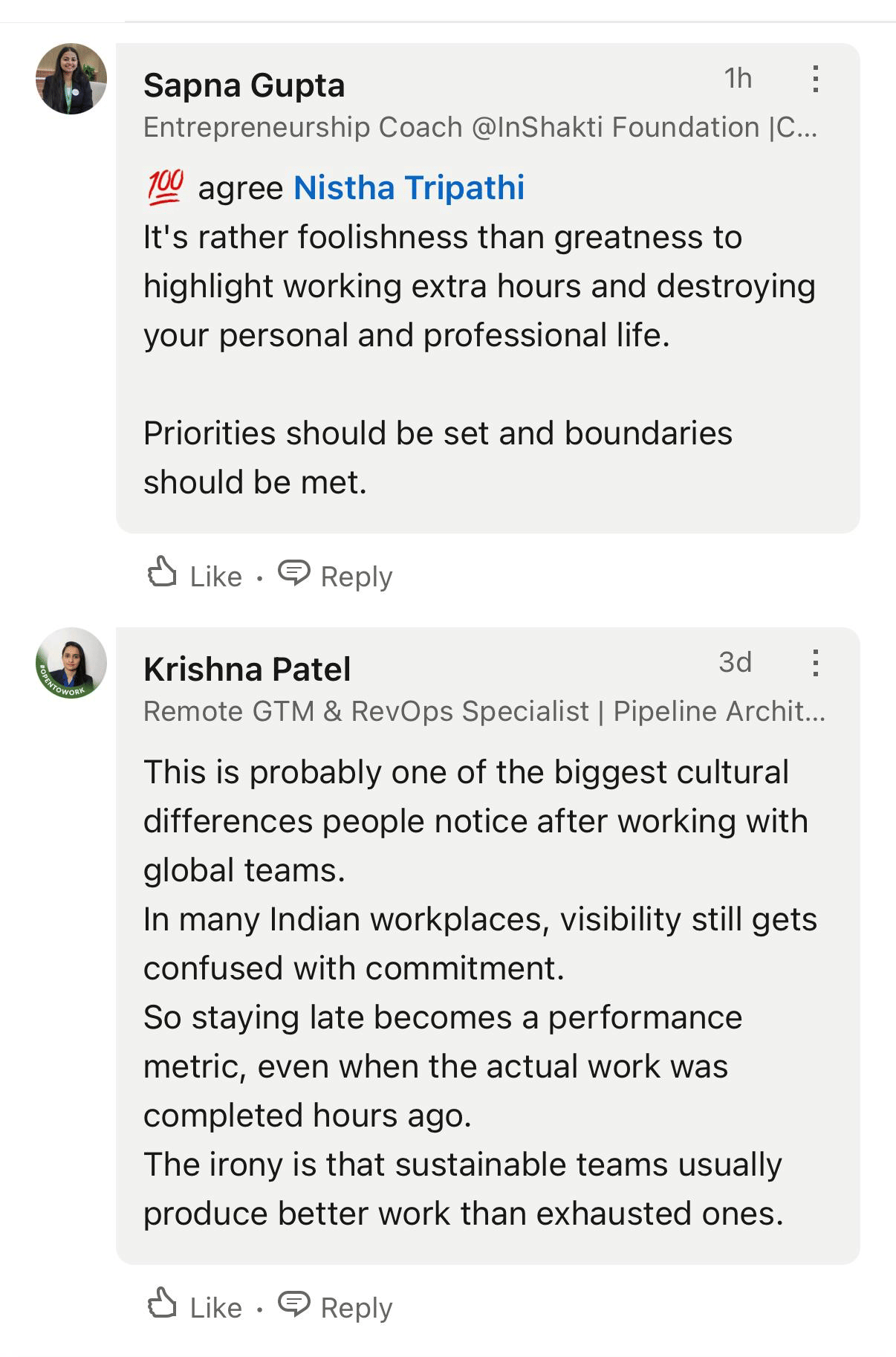
Dhananjay wrote, “Great point. Trust based work cultures drive better outcomes than time-based ones.”
Saurabh commented, “True, If we don’t respect ourself , no one would do so as well.”
Harvinder penned, “This is very relatable. In many workplaces, staying late is still seen as commitment, while leaving on time feels like a lack of dedication. The real shift needed is from measuring hours to measuring outcomes. When expectations are clear, people can deliver without stretching their workday unnecessarily.”
Shubham Goel added a sarcastic take, writing, “Waiting for the day I see a JD that finally admits it: ‘Role: Human 7-Eleven. Requirements: No closing hours and high-voltage energy 24/7’.” 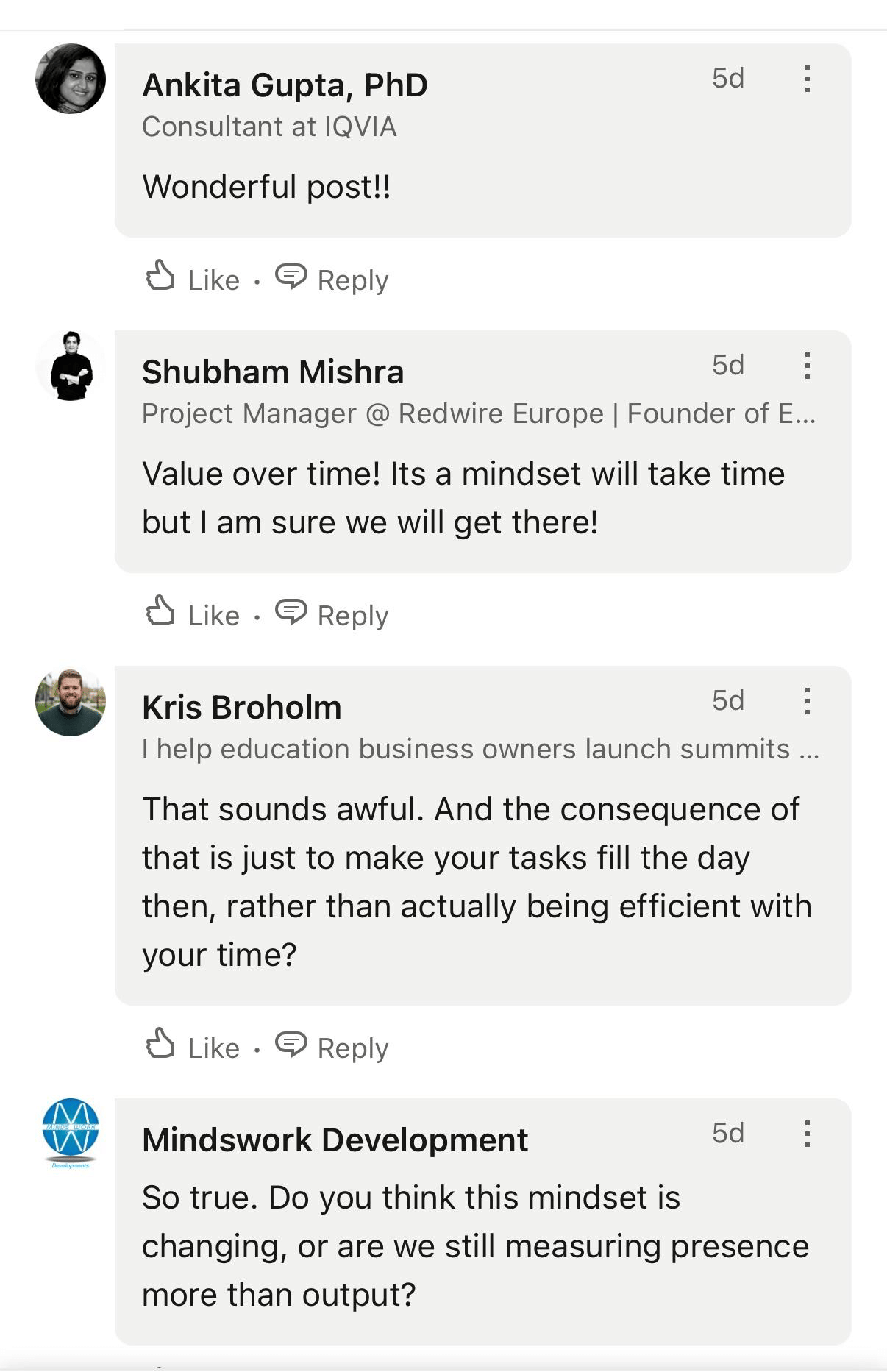
Another user, Shubham Mishra, wrote, “Value over time! It’s a mindset will take time but I am sure we will get there!”
Saurabh shared his own experience and said, “Been there, done that and this is exactly what stung me the most !!!”
Narayanan commented, “In India availability has become a habit- not a choice. We have always believed in more hours means more dedication that thinking needs to evolve-work should be measured by output not time.”
M. Hashir wrote, “Cheap & easy available Employee/labour has no right, no view point and no dignity.Taken for granted was always there in Indian job market”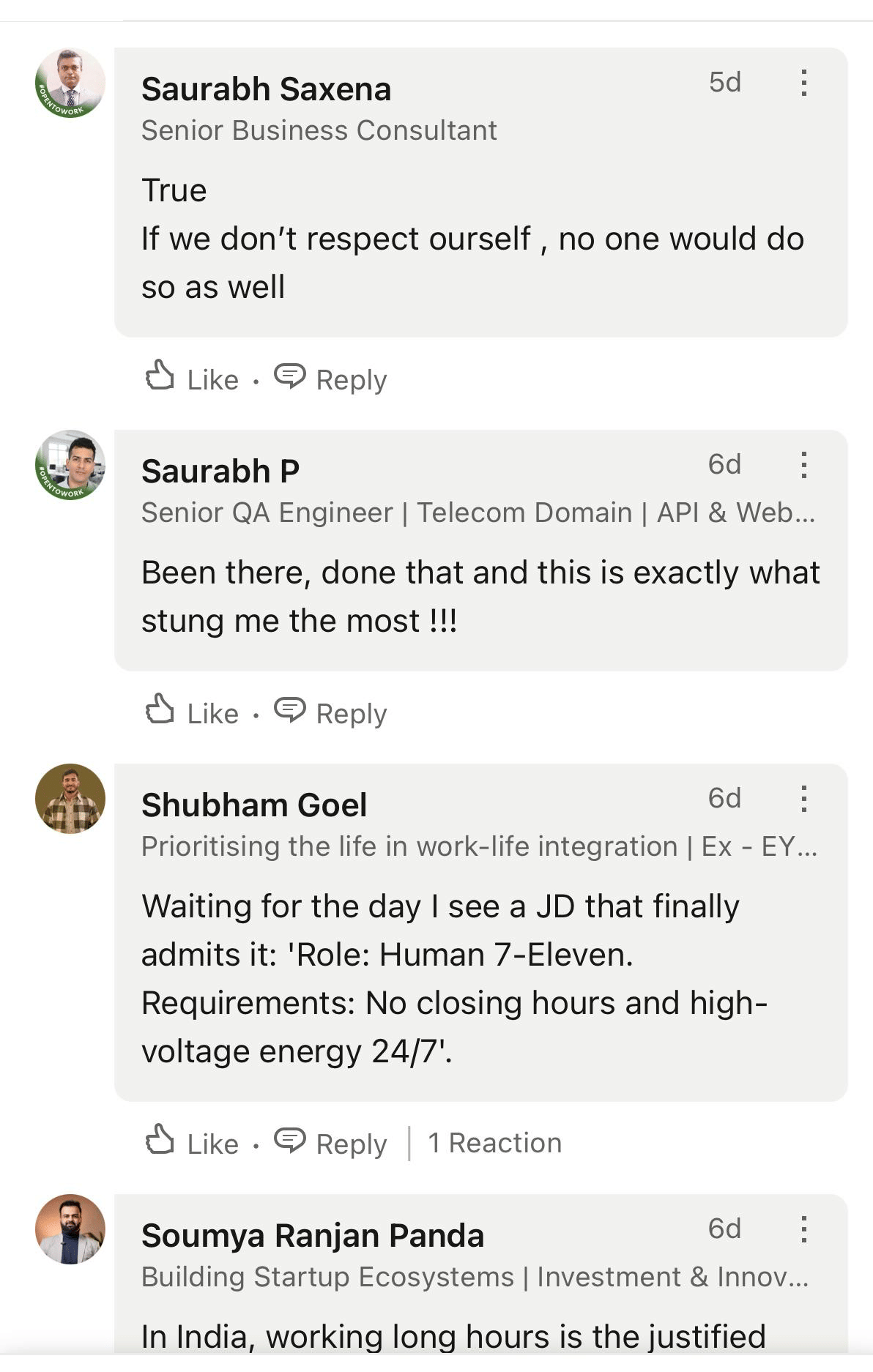
A user named Mindset Development asked, “So true. Do you think this mindset is changing, or are we still measuring presence more than output?”
Sabyasachi commented, “We have a slavish mentality due to the adverse history of foreign dominance combined with a traditionally feudal mindset. Dominance over others is a great satisfaction for us indicating success!”
David added, “The scary part isn’t AI replacing jobs, it’s how fast relevance can fade if we stop evolving. The real edge now is adaptability.”
A conversation many employees were already having quietly
The post may have begun as one founder’s perspective, but the replies showed that it reflected a much larger reality for many working professionals in India. From late-night calls and pressure to stay online to being judged for leaving on time, the debate brought up an important question: should dedication be defined by long hours or by the quality of work delivered?