


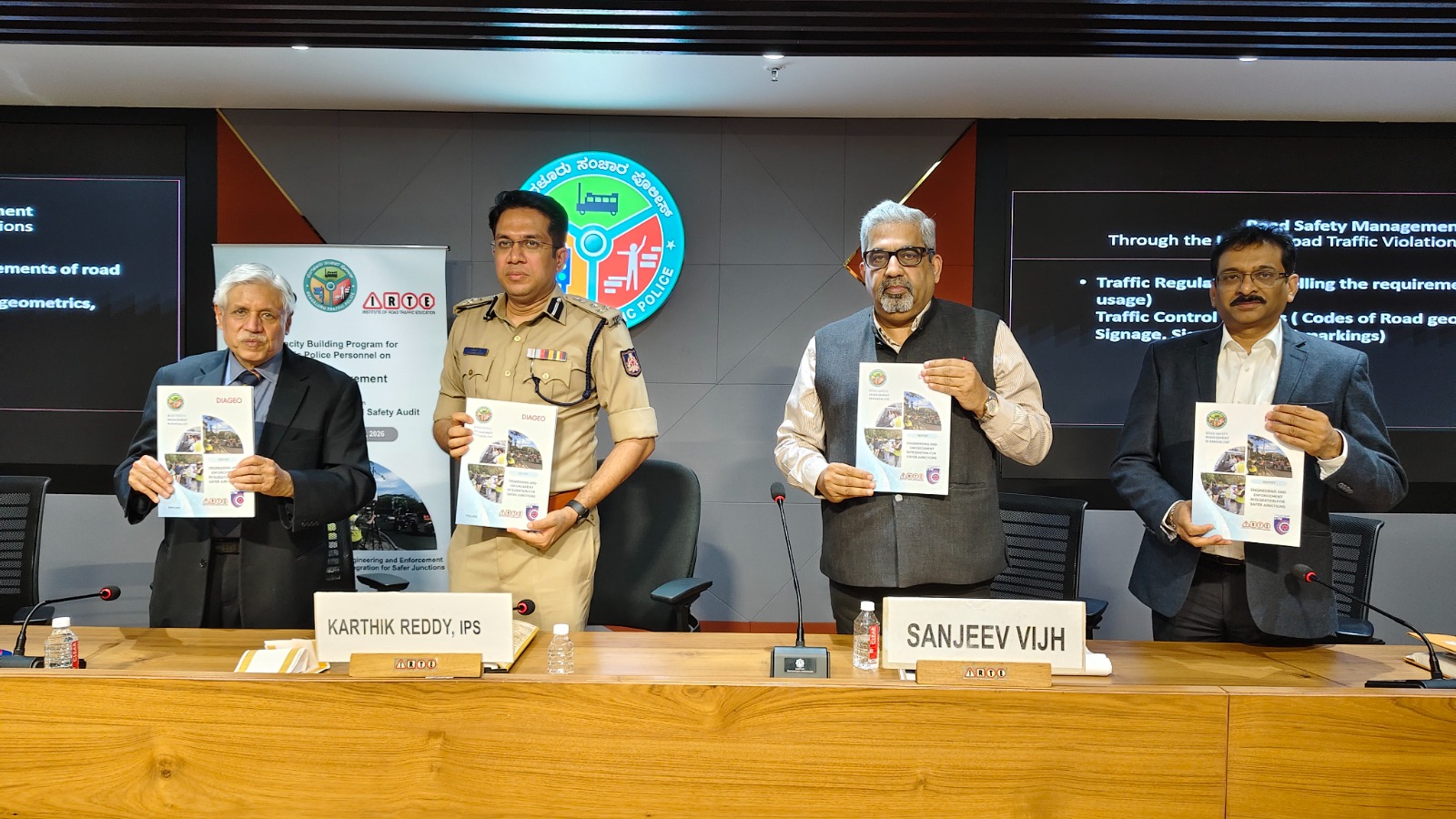
Bengaluru, one of India’s fastest-growing metropolitan cities, is home to over 14 million residents and more than 1.2 crore registered vehicles, placing significant pressure on its road infrastructure and resulting in some of the highest congestion levels globally. Against this backdrop of evolving urban mobility needs, Diageo India (United Spirits Limited), in collaboration with the Institute of Road Traffic Education (IRTE) and the Bengaluru Traffic Police (BTP) have partnered to create a Road Safety and Traffic Engineering Improvement Study aimed at enhancing safety and efficiency at key intersections across the city.
This initiative has been undertaken as part of Diageo India’s Corporate Social Responsibility (CSR) commitments, focused on benefitting the communities in and around which it operates. Recognizing urban mobility as a critical priority in Bengaluru, the programme brings together research, on-ground assessment, and capacity building to support scalable, high-impact solutions.
Study Overview & Key Insights
The study assessed three key intersections, Chalukya Circle, Cantonment Railway Station Junction, and H. Siddaiah Circle, using a scientific, data-driven methodology combining traffic volume analysis, behavioural observations, and road safety audits. These locations were selected to represent diverse urban contexts: administrative, transport hub, and recreational zones.
Importantly, the study is designed as an evidence-based, solution-oriented exercise, with a focus on identifying practical interventions that can enhance traffic flow and user experience in complex urban environments.
Its insights highlight the importance of a multi-stakeholder approach, bringing together traffic police, municipal corporations, urban local bodies, and road-owning agencies. The study reinforces that improving urban mobility requires coordinated action across engineering, enforcement, and infrastructure planning, rather than isolated interventions.
The analysis provides insights into:
- Traffic movement patterns and intersection performance
- Pedestrian usage and crossing behaviour
- The role of road design and infrastructure in influencing traffic flow
- Opportunities to improve efficiency through better planning and design
The study also outlines a set of practical, low-cost engineering interventions, such as improved lane channelization, pedestrian refuge islands, optimized signal placement, and enhanced signage, which can contribute to improved traffic efficiency and safer road environments.
Capacity Building for Traffic Police
As part of the initiative, a two-day structured training programme for Bengaluru Traffic Police officers was conducted on March 30 & 31, 2026. Designed by IRTE, the programme draws on over 35 years of experience in training police personnel across India, including at premier institutions such as the SVP National Police Academy.
The training covers:
- Fundamentals of traffic engineering
- Road Safety Audit (RSA) concepts
- Application of Motor Vehicles Driving Regulations in real-world scenarios
The objective is to enhance on-ground decision-making, strengthen enforcement effectiveness, and enable officers to identify systemic road safety issues, contributing to long-term improvements in traffic management.
Karthik Reddy, IPS, Joint Commissioner of Police (Traffic), Bengaluru City said: “Managing traffic in a city like Bengaluru requires a strong understanding of enforcement, road engineering, and on-ground realities. Initiatives like this play an important role in strengthening the capacity of our officers and bringing valuable technical insights into day-to-day traffic management. Greater coordination between planning, engineering, and enforcement agencies, along with a focus on both vehicular movement and pedestrian safety, will be key to improving traffic efficiency and making our roads safer for all.”
Devashish Dasgupta, Corporate Relations Director, Diageo India (USL) said: “Diageo India (United Spirits Limited) is committed to creating a positive impact in the communities where we operate. Urban mobility is one of the most pressing challenges in Bengaluru today. Through this collaboration with IRTE and Bengaluru Traffic Police, we are taking a science-based, data-driven approach to improving traffic flow and road safety. Starting with a pilot study across three key junctions and capacity building sessions, we aim to scale this initiative in a phased manner.”
Rohit Baluja, President, Institute of Road Traffic Education (IRTE) said “Traffic regulation is fundamentally a traffic engineering discipline—designed not only to ensure safety but also to optimize efficiency in the movement of people and goods. Effective enforcement is only possible when supported by road infrastructure that adheres to established traffic engineering principles.
To empower Traffic Police Officers to regulate traffic effectively, it is essential that they understand the fundamental requirements that road infrastructure must meet. This enables them to assess whether road users are realistically able to comply with traffic laws. Additionally, a clear understanding of Road Safety Audits is critical, as it helps police officers relate enforcement challenges with roadway design, operation, and maintenance agencies.
In practice, the Traffic Police are often regarded as the nodal agency for a wide range of traffic-related issues, including road safety, congestion management, VIP movement, and public education—many of which fall within the mandate of road and transport authorities. Over time, this has placed significant responsibility on the police, often by default rather than by design. Therefore, capacity building of Traffic Police Officers is crucial. Strengthening their technical understanding and operational capabilities is key to achieving sustainable improvements in both road safety and traffic efficiency.”
The initiative establishes a replicable model for improving urban intersections, combining research, engineering solutions, and enforcement training. By aligning multiple stakeholders, it aims to contribute to improved traffic efficiency, safer road environments, and more sustainable urban mobility in Bengaluru.