Every generation returns to the Last Supper. Not out of reverence alone, but because the scene refuses to settle. It holds within it betrayal, theatre, power, and the uneasy proximity between faith and doubt. Artists have long used it as a framework—but what they reveal says more about their moment than the scripture itself.
The version that commands attention today is not Renaissance, nor surrealist, nor pop. It is the one painted by Francis Newton Souza—an image that strips the narrative to its nerves and leaves it exposed.
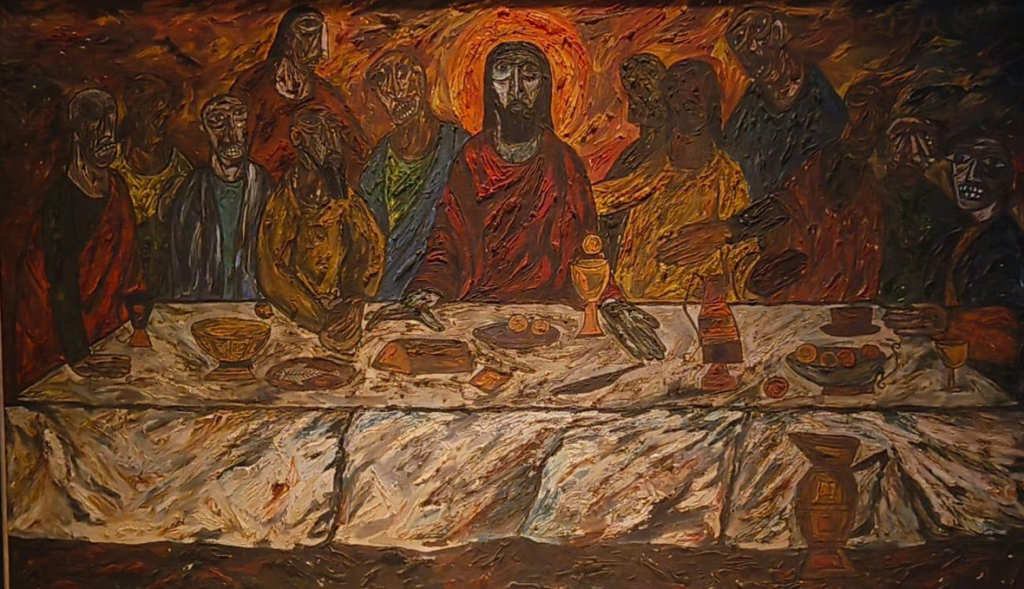
In Souza’s hands, the Last Supper is no longer a composition of balance. It is an arrangement of tension. Christ remains central, but not as a figure of calm authority. He is alert, almost severe, haloed yet unsoftened. Around him, the apostles dissolve into a gathering of uneasy presences—faces distorted, expressions fractured, each figure locked in private conflict rather than shared faith. The table is intact, the symbols recognisable—bread, wine, the ritual of gathering—but the idea of communion has collapsed.
This is the painting’s force: it does not narrate the moment of betrayal, it inhabits it.
To understand how far this departs from tradition, one has to return briefly to The Last Supper by Leonardo da Vinci. Da Vinci constructed a world of order—measured gestures, controlled emotion, a carefully orchestrated response to Christ’s revelation. Even in its drama, the painting holds together.
That coherence does not survive in Souza.
Where the Renaissance sought structure, Souza introduces rupture. Where earlier artists aimed for transcendence, he insists on the body—on its distortions, its discomfort, its undeniable presence. His figures are not idealised disciples; they are flawed, watchful, implicated. The sacred is not denied, but it is unsettled.
Other modern interpretations of the Last Supper have taken different routes. Salvador Dalí elevated the scene into a vision of cosmic stillness, dissolving the human drama into something ethereal. Andy Warhol, decades later, reduced it to an image in circulation—repeated, flattened, almost emptied of spiritual weight.
Souza does neither. He neither elevates nor erases. He confronts.
That confrontation is rooted in biography as much as in style. Raised within a strict Catholic environment in Goa, Souza absorbed its imagery early—but his relationship with it was never simple. His work repeatedly circles back to religious subjects, not as a believer might, but as a sceptic compelled to return. The Last Supper becomes, in this context, less a sacred episode and more a site of inquiry—about authority, guilt, desire, and the uneasy performance of faith.
It is also worth noting that Souza did not treat the subject as a one-off. He returned to it across his career, testing its limits, shifting its tone, amplifying its psychological charge. Yet the version that stands out—the one that anchors this exhibition—feels the most distilled. There is nothing decorative here, nothing that softens the blow. The painting operates with a kind of directness that is difficult to ignore.
Placed within the longer lineage of the Last Supper, Souza’s work does something quietly radical: it removes the comfort of distance. The viewer is no longer observing a sacred past; one is drawn into an immediate, unsettled present.
And that may be why it feels so relevant now.
In a time when certainty—religious, moral, or otherwise—appears increasingly fragile, Souza’s Last Supper does not attempt to restore belief. It exposes its tensions. It replaces clarity with ambiguity, unity with fracture.
The story remains the same. The meaning does not.