






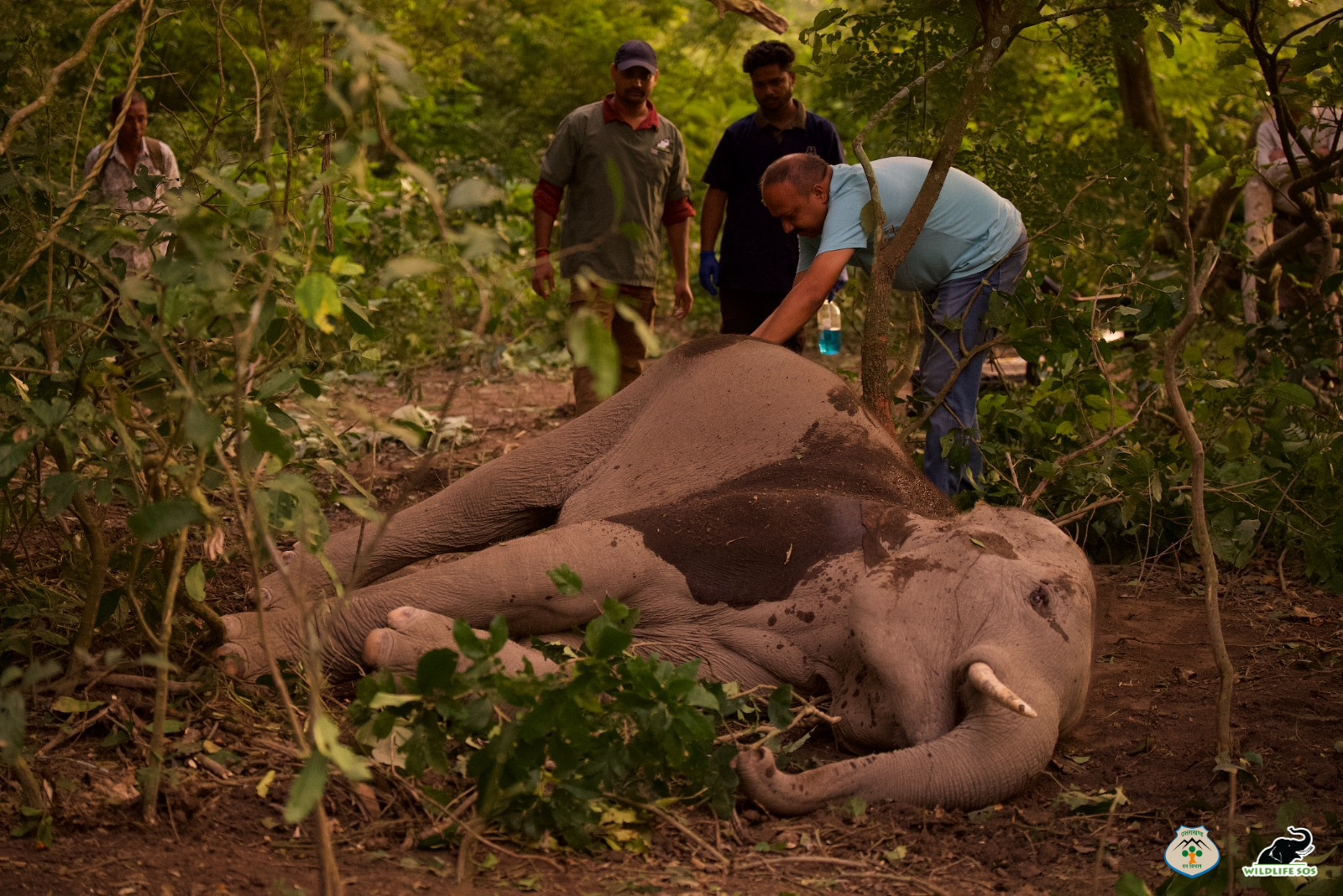
Wildlife SOS specialists support Uttarakhand Forest Department veterinarians in a coordinated effort to treat and reunite a young elephant with his herd, highlighting the importance of inter-agency cooperation in wildlife emergencies.
In a heartening outcome for wildlife conservation, an approximately eight to nine-year-old wild elephant found trapped in a pit in Uttarakhand’s Peepal Padao forest range was successfully rescued, treated and reunited with its herd, following a coordinated intervention by the Uttarakhand Forest Department and Wildlife SOS. Found on the night of 25 October, the elephant was rescued from a pit approximately one metre deep. Despite being brought out, the young elephant remained unable to stand independently. The Forest Department’s veterinary team-initiated treatment and closely monitored the elephant’s condition before involving Wildlife SOS specialists to provide additional expertise and support.
A Wildlife SOS team travelled to the site to join the Forest Department’s veterinarians in assessing the elephant’s condition and determining the next course of treatment. The examination revealed swelling in the upper back region. X-rays indicated a suspected soft-tissue injury. Although the animal can move all four limbs, it remains unable to support its body weight on its forelimbs and stand independently.
Working alongside the Forest Department’s veterinary team, Wildlife SOS specialists provided supportive care, including fluid administration for rehydration, laser therapy, pain management and wound dressing. With the assistance of a JCB and sling, the teams facilitated an assisted lifting attempt, following which the elephant successfully stood up independently. In the subsequent assessment, swelling and lameness were observed in the right forelimb. The elephant was offered green fodder and sugarcane, and consumed approximately 8–10 kg of green fodder and 15–20 litres of water. The veterinary team initiated symptomatic treatment and continued to monitor his condition. No injections or topical medications were administered after he stood up.
The Uttarakhand Forest Department has demonstrated a proactive approach to wildlife care by bringing in specialised expertise and facilitating collaboration between veterinary teams to address the young elephant’s complex medical needs. The department’s initiative reflects the importance of recognising when additional expertise can strengthen ongoing treatment and improve the care available to injured wildlife. Wildlife SOS feels honoured to support the Uttarakhand Forest Department in this effort, building on its previous collaborations with the Uttarakhand Forest Department on wildlife rescue and conservation interventions in the past.
Following the treatment and monitoring, the elephant was successfully reunited with his herd and returned to the wild. His recovery from being unable to stand independently to standing on his own, followed by his reunion with the herd, marks a heartening outcome of the collaborative intervention.
Shri Umesh Chandra Tiwari, IFS, DFO, Uttarakhand Forest Department, said, “When the young elephant was rescued from the pit, its inability to stand independently was a major concern for our team. Our veterinarians worked continuously to provide the necessary care, and bringing in Wildlife SOS specialists helped strengthen our treatment efforts. Seeing the elephant regain its ability to stand and eventually reunite with its herd is an extremely encouraging outcome. We appreciate the support and expertise extended by Wildlife SOS, and this experience reinforces the importance of collaboration in responding to complex wildlife emergencies.”
Baiju Raj M. V., Director, Conservation Projects, Wildlife SOS, said, “It was a challenging situation, particularly given the elephant’s inability to stand despite being safely rescued from the pit. The Wildlife SOS team supported the Uttarakhand Forest Department’s veterinarians, providing treatment and exploring ways to help the animal regain its mobility. The moment the elephant stood independently was immensely encouraging. To learn that it has since reunited with its herd makes this an especially rewarding outcome for everyone involved. We are grateful to the Forest Department for its proactive approach and collaborative efforts throughout the intervention.”
Geeta Seshamani, Co-Founder and Secretary of Wildlife SOS, said, “Every wildlife rescue carries its own challenges, but few outcomes are as heartening as seeing an animal return to the wild where it belongs. This young elephant’s journey, from being trapped in a pit and unable to stand to regaining its strength and reuniting with its herd, is a positive example of what coordinated efforts and compassion can achieve. We deeply appreciate the Uttarakhand Forest Department’s commitment to wildlife welfare and are honoured to have supported its team in bringing about this positive outcome. Knowing that the elephant is back with its herd is the best possible news for all of us.”
The successful intervention highlights the importance of timely veterinary care, specialised expertise and coordination between wildlife authorities and conservation organisations. While the elephant’s initial condition presented significant challenges, the combined efforts of the Uttarakhand Forest Department and Wildlife SOS helped it regain its mobility and return to its natural social group.
Wildlife SOS works with Forest Departments and other authorities on wildlife rescue, veterinary care, rehabilitation and conservation initiatives. Its collaboration with the Uttarakhand Forest Department in this case further underscores the value of bringing together government veterinary teams and specialised wildlife-care organisations to respond to challenging emergencies, with the animal’s welfare remaining the shared priority.