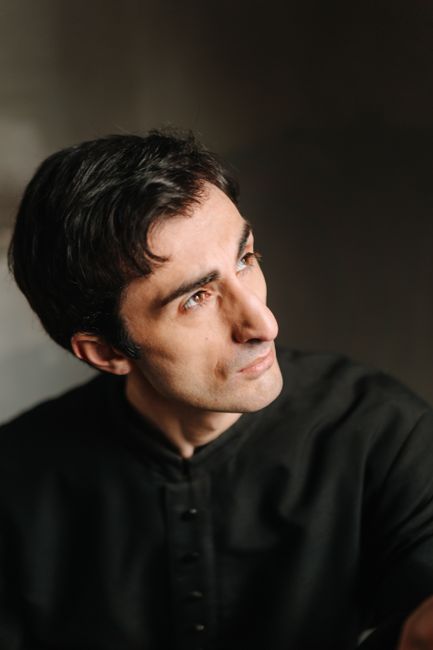
There’s progressive rock and metal alongside sitar and sarod on the nine-track album, released via American label GroundUP Music
Seasoned sitar artist Purbayan Chatterjee has had plenty of experiments in fusion, but his new album Feathered Creatures dives into electronic territory as well as guitar-heavy improvisation courtesy of American guitarist-composer Mark Lettieri (from fusion jazz group Snarky Puppy), offering contrasting sounds tied together by the malleable Indian classical form.
Chatterjee – who previously worked with Snarky Puppy’s founder Michael League on 2021 album Unbounded (Abaad) – was already leaning in a production-based, electronic music-informed direction with help from producer Nakul Chugh. “I wanted to add new sounds to my repertoire, and also take it to the EDM space and find some relevance with the Gen Z audience till Mark [Lettieri] got into it,” Chatterjee says over Zoom.
After Chatterjee joined Snarky Puppy on stage at their Mumbai show in December 2023, League heard some of the sitarist’s upcoming songs and suggested it could use guitars. “Mark was the first person I thought of. He played on these songs initially as a session artist and it turned into a full-blown collaboration,” Chatterjee recalls.
Together, Chatterjee and Lettieri, along with an ensemble lineup, performed at Nita Mukesh Ambani Cultural Centre’s Grand Theatre in early January for a concert called The Sitar Stories. Then, an American lineup, including drummer/percussionist Varun Das, came together for “work-in-progress” residency shows at Montgomery College in Washington D.C. in April. There’s also an upcoming show for Feathered Creatures coming up in August in Kolkata, while 2027 is likely to see a U.S. tour as well as an India tour.
The spaces that Chatterjee’s thinking of could be clubs or bigger stages — anywhere that the electronic elements can make people move to the music. “But the music also has a lot of intelligence built into it, so some of the rhythmic cycles are like eight and a half beats… and seven and a half beat cycle. It’s intelligent [music], rhythmically and harmonically speaking,” he explains.
On the nine-track album, “Shallow Water Blackout” veers into hard rock and metal territory with Lettieri’s riffs matching Chatterjee’s scorching sitar work, while electronic beats gallop and morph. Thumping rhythms underscore Chatterjee’s playing on “Rise Enshrined,” and there’s a more uplifting energy through “Bridges.” Chatterjee rides 2-step/U.K. garage-style beats for one of the best examples of his fusion on “9000 Miles,” with sprightly guitars and vocal harmonies. “Soar” is breezy and bright in its treatment, with twists and turns that are meant to excite. “We’ve brought on a whole new relevance to Indian music, I think that’s where we stand today,” he says.
Chatterjee mentions how listening to psytrance, the Buddha Bar albums, and artists like Paul Van Dyk’s song “Ibiza” contributed to his understanding of electronic music, while also name-dropping prog metal as an influence. “Like Dream Theater. [Keyboardist] Jordan Rudess is a buddy of mine and we’re also working on some music,” the sitarist adds.
Sarod artist Pratik Shrivastava completes a trio of string instruments on “Sarode Sevens,” the combination of sitar, sarod and guitar becoming one of the most engaging tracks on Feathered Creatures. Elsewhere, “Hibiscus” brings in tabla great Satyajit Talwalkar for a playful jazz-fusion take, dedicated to Indian music legend Ustad Zakir Hussain. There’s another dedication to the late artist as well on the closing track “ZH.”
How does one pay tribute to an artist only through sound and not so much through words? Chatterjee says, “Zakir bhai is a person who has transcended genre, language and made the tabla a global instrument. Even though it’s not a melodic or harmonic instrument, he transformed the tabla into an almost talking, breathing, living kind of force. I went with what crystallizes in my mind when I thought of him.”
Through albums like Feathered Creatures, Chatterjee is also pushing sitar music globally, following in the footsteps of legends like Pandit Ravi Shankar. Some of his involvement in the legacy of the sitar legend is now extending into film.
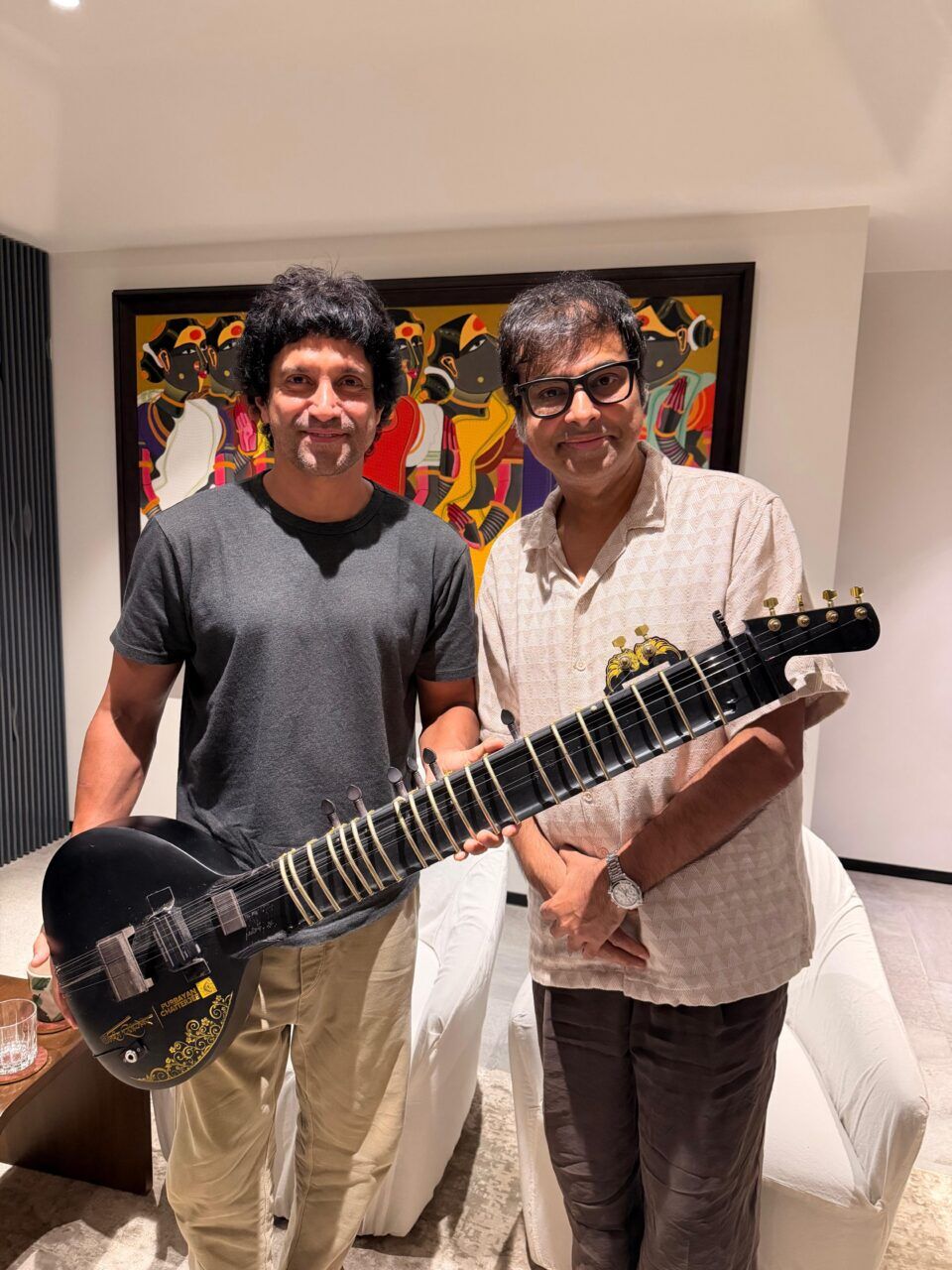
The upcoming series The Beatles – A Four-Film Cinematic Event features Farhan Akhtar essaying the role of Pandit Ravi Shankar, and the actor-singer has teamed up with the Purbayan Arts and Artists Music Foundation to learn sitar. Chatterjee recalls, “He never told me that it was for this particular role, because he wasn’t allowed to, he was behind an NDA. He just said he has to play a role which required him to be a sitar player. He said, ‘It’s about the role, but I also just want to learn the sitar.’”
After his first meeting with Chatterjee, his student, Ruthvik Rao, was sitting with Akhtar to train him on how to play the instrument. “I showed him a little bit of sitar technique, his left hand, right hand fingering, and boom — just in one meeting, he was already playing Sa Re Ga Ma. I was really impressed, and he’s in touch with me constantly,” Chatterjee says.
Without Ravi Shankar, Chatterjee says he wouldn’t be “sitting here today so proudly talking about an album done with an American musician, launched by an American label [GroundUP Music].” He does, however, add, “At the same time, I think we ought to do more for them [Indian music legends like Ravi Shankar and Zakir Hussain].”
In all, his hopes for the sitar and music from India in general are simple. “There should not be a celebration of mediocrity. I feel like there’s this herd mentality when a certain kind of song works or a singer goes viral with a certain voice texture and everybody tries to sing like him or her. Or if a kind of sound goes viral, everybody tries to make music like that.” He adds, “We need to make an environment where originality, where brilliance are celebrated, not just numbers, algorithms and what’s going to sell.”