
For Sheel Jaitley, 42, it was a no-brainer. Her son suffered frequent wheezing and nasal congestion in Bengaluru, where he was born in 2016, but recovered magically every time she visited her family in Manipal, a suburb of Udupi in coastal Karnataka. For the high-flying cityhopper with a successful corporate career, the decision was well-considered but inevitable. In 2024, the family moved from Bengaluru to Manipal.
Jaitley’s income took a hit after she left her job and launched an edtech startup, Fuggae. Her husband, a Securities and Exchange Board of India (Sebi)-registered investment adviser, travels frequently between Delhi and Manipal. Still, Jaitley is happy with the trade-off. “It’s cleaner, greener, safer, with fewer health issues, and no traffic or societal pressure to maintain a fancy lifestyle. We also don’t have to wait till Diwali to meet the family,” she says.
It’s a transition many in the metros dream of, but seldom make because the decision to relocate often rests on the fragile balance between the quality of life and cost of living, between income and expenses, priorities and trade-offs. The draw of a lucrative job, career options, and top-tier medical, educational, and public infrastructure in metros weighs against the need for a pollution-, traffic-, and stress-free life in a tier 2 city. So far, the balance has remained largely skewed, with the eight metros and tier 1 cities (Delhi, Mumbai, Chennai, Kolkata, Bengaluru, Hyderabad, Ahmedabad, Pune) preferred over the tier 2 cities. The skew may have shifted a bit now.
“While top cities continue to remain the largest economic engines, some tier 2 cities have evolved into well-established regional hubs driven by augmented infrastructure, connectivity and business activity,” says Ankita Sood, National Director, Research, Knight Frank India. “Lucknow, Kochi, Chandigarh, Jaipur, Indore, Bhubaneswar, Goa and Coimbatore, among others, continue to stand out due to improving connectivity, expanding economic ecosystems and strengthening social infrastructure, all of which are contributing positively to the overall liveability,” she adds.
For 39-year-old Vaibhav Jain, who shifted from Bengaluru to Indore last year after “quitting the corporate rat race”, the decision was imminent. “I was very sure I wanted to shift to a tier 2 city and the move was expedited when my daughter was born,” says Jain, whose income has come down 40-50% ever since he shifted and started his own venture. “If my venture doesn’t take off in 2-3 years, I’m flexible about moving back to a metro,” he says, despite enjoying all the perks of a small city— lower expenses, lesser pollution, and more time with the family.
ALSO READ | Your monthly spend also decides how soon you can retire: Expense tracking apps, AI tools are changing how Indians invest
The fall in earning capacity in a tier 2 city is often the deciding factor for many who are otherwise strongly inclined to embrace a better quality of life. Here are some factors to consider before deciding to relocate.
Quality of life & cost of living: Metro vs tier 2
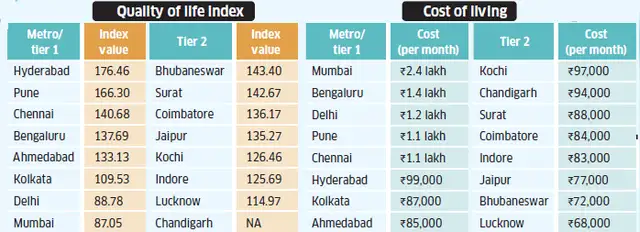
Sources: Numbeo, Costoflivingindia. com. Data sites are crowdsourced. Figures/values are indicative and could vary. Figures are rounded off. Quality of life index takes into account various parameters like cost of living, purchasing power, housing affordability, pollution, healthcare, traffic, and crime rate. Cost of living for a family with kids includes 3-BHK rent in city centre, dining, groceries, utilities, transport, household help, shopping, lifestyle & entertainment and miscellaneous spends. Tier 2 cities chosen randomly
Career growth & future income
It’s important to consider your career stage while deciding to make a shift. For earlystage professionals, it’s best to explore opportunities in tier 1 cities and move to tier 2/3 cities only after gaining experience. “In the very early stages of a career, tier 1 cities have an edge over tier 2/3 cities because you learn through peers, mentors, leaders, friends, and the entire ecosystem is set for you to learn and grow practically on a daily basis,” says Neeti Sharma, CEO, TeamLease Digital.
If career growth is a priority, you will need to make a calculated, informed decision. “If moving to a smaller city reduces visibility, your career will suffer. The main reason for a slowdown is not geography, but professional isolation. To maintain momentum, you will need to keep your top relationships active, stay visible on LinkedIn and company events, and take on impactful work,” says Devashish Chakravarty, Founder, QVerify, an employee background verification firm, and a regular ET Wealth columnist.
Jaitley knows it well. “My networking has suffered because it takes a hit outside metros, especially if you are launching a startup and require funding as well.”
Sharma has a counter view. “Career growth today is becoming more skill-based than just city-based, especially in roles across tech, finance, human resources and analytics. What matters is the skills and value one brings to the table,” she says.
ALSO READ | Paying extra for MF-PMS? Here’s what investors get and what they may lose on returns
What also matters is the fewer opportunities available in tier 2 cities. “One of the biggest challenges is the lack of job opportunities in Chandigarh, especially in the IT sector,” says 40-year-old Akashdeep Garg, a data engineer-turned-financial adviser, who moved to Chandigarh in 2022. His wife, Rohita, still travels to Gurugram for one week every month. “She’s working in the hybrid mode, but if she switches to a Chandigarh-based company, she might need to compromise on the hike,” he adds.
If you are considering self-employment, it will require not only networking but also better financial preparation, with a 6-12 month cash-flow contingency to sustain your lifestyle while incubating a new venture. “Expect 30-50% income volatility immediately after you switch to self-employed or remote work. As you stabilise your income pipeline, the volatility can reduce to 20% over a three-year period,” says Chakravarty.
Also, take into account the periodic travel to metro areas and other cities for networking, funding, and client meetings.

Anuj & Simran
Kesarwani, 35 & 29
Financial planners
Benefits
- Lower pollution, better food quality.
- Higher interaction with family, friends.
Drawbacks
- Medical infrastructure better in metros.
- Professional networking impacted.
Fall in income
10-20%
Fall in expenses
30-40%
Note:It’s difficult to afford a house before marriage in a metro and the quality of life in a tier 2 city is much better.
Property prices & rentals
Unless you have a family house or are moving in with your parents, a crucial decision is whether to buy or rent immediately after shifting to a smaller city. Many are attracted to the lower property costs and home loan EMIs (equated monthly instalments), which can easily translate to a bigger house.
“I have bought a 220 sq. yard plot of land and will construct a 4 BHK house later, which will cost me around Rs.2.5 crore overall. For the same price, you would never be able to buy and build a kothi (independent house) in the National Capital Region (NCR) of Delhi,” says Garg, who is currently living on rent in Chandigarh.
“In metros, the average cost of a 2-BHK (bedroom, hall, kitchen) house is around Rs.1.25-1.5 crore, while a 3 BHK can cost approximately Rs.2.25-2.5 crore. In tier 2/3 cities, a 2 BHK typically ranges from Rs.80 lakh-1 crore, while a 3 BHK may cost around Rs.1.3-1.5 crore,” says Ritesh Mehta, Head— North, West & East, Residential Advisory Services, India, JLL.
The rents also vary sharply. “You pay anywhere between Rs.40,000 and Rs.70,000 per month for a decent 2-BHK house in Mumbai or Delhi. You will find the same configuration in Indore, Coimbatore or Nagpur for Rs.10,000- 18,000, a saving of Rs.25,00-50,000 every month,” says Santhosh Kumar, Vice Chairman, ANAROCK Group.
“These days one is expected to have a house before one gets married, but given the high property prices and loan EMIs in Mumbai and Navi Mumbai, it’s impossible to afford one for 80% of the employees. This may not be true for those in the IT sector, but they too are facing uncertainty now,” says Anuj Kesarwani, Founder, Zenith Finserve, a financial planning firm. Kesarwani shifted to his family house in hometown Prayagraj (formerly Allahabad) from Navi Mumbai this year.
However, it may not always be prudent to buy property right away. “Ideally, one should begin by renting. Buying a property requires a deeper understanding and familiarity with the location, infrastructure, and long-term liveability. It is advisable to spend at least 2-3 years in the city before making a purchase decision, irrespective of the prevailing market conditions,” says Mehta.
“That said, in tier 2 cities such as Indore or Jaipur, property prices are low enough for the EMIs to actually be on a par with monthly rent, which makes buying a real wealth-building decision if you are sure about staying for the long term,” says Kumar. That’s another thing you will need to watch out for—whether you are sure of settling in the small town forever.
Remember, that in case you decide to move back to a metro, it may be slightly difficult to sell the property. “Liquidity can be one of the biggest challenges in tier 2/3 markets. Property sales may take longer due to the relatively lower demand and excess supply in certain locations. Additionally, promised infrastructure and social development may face delays or may not materialise as expected, which can impact resale prospects and appreciation,” says Mehta.
Property rates, rents lower in tier 2 cities
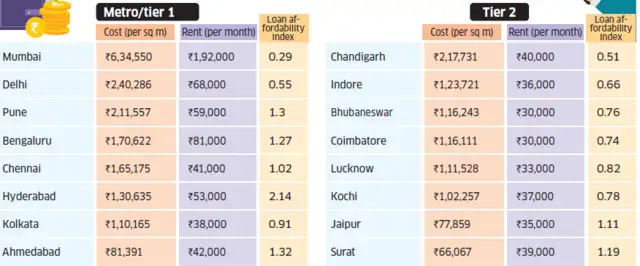
Source: Numbeo. In loan affordability index, higher values indicate better affordability. Rent is for a 3-BHK apartment in city centre. Data site is crowdsourced. Figures are indicative and could vary. Some figures are rounded off.
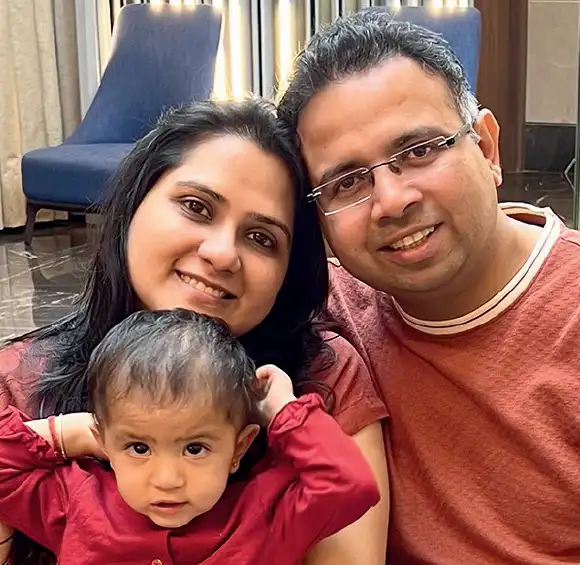
Vaibhav & Aditi Jain
39 & 36
Entrepreneur & homemaker
Benefits
- Better quality of life.
- More time with family.
Drawbacks
- Fall in income due to a startup.
- Professional interaction reduced
Fall in income
40-50%
Fall in expenses
10-20%
Note:If my venture doesn’t take off in another 2-3 years,I’m flexible about moving back to a metro.
Cost of living, quality of life
There is also a significant difference in the cost of living between metros and tier 2 cities (see table). According to Costoflivingindia.com, a family with kids will spend approximately Rs.1.2 lakh a month in Delhi, while you will need to shell out around Rs.77,000 in Jaipur.
While these figures are tempting enough to relocate to a tier 2 city, remember that your income is also likely to come down, cutting down your actual savings. If, however, you are able to maintain the same income level, it could result in high savings. “The relocation should typically be a positive move since rentals, cost of living, school and doctors’ fees would be lower. If the salary remains the same, one should take care to invest the potential savings to enhance one’s lifestyle or redirect to retirement funding,” says Suresh Sadagopan, Founder, Ladder7 Financial Advisories.
However, one is also likely to make a mistake regarding the overall spending. “A general assumption is made on the topline costs such as food, stay and other basic amenities. The gaps pertaining to infrastructure, utilities, and other essential services should also be assessed,” says Dinesh Rohira, Founder & CEO, 5nance.com.
This is what Jain discovered when he moved to Indore. “I realised that my expenses had come down barely 10- 20% because of the lifestyle, while my income had been slashed considerably (due to the startup),” he says.
“It’s important to consider the quality of life and lifestyle one wants to have, as well as the cost differential associated with living in a metro and tier 2 city,” says financial planner Kesarwani. “For instance, if you want to spend more time with your family and friends in your home town, it’s worth making the move,” he adds.
Quality of life was a deciding factor for Garg too. “While cost was a factor, more important was the better quality of air and water, lower commute time and traffic jams, and having my family closer in Punjab,” says Garg, who takes 15 minutes to travel to work, compared to an hour he took in the NCR.
On the flip side, not everyone may be able to adjust to a small-city life after the comforts and conveniences of a metro city. Varun Naidu, 59, realised this when he shifted from Mumbai to Goa in 2007, wanting to escape the toxic corporate rat race. “Though the quality of life improved significantly—no pollution, lesser traffic and more time with the family—it took me a long time to adjust to the city’s culture, mindset, and frequent disruption of power and water supply.
The difference in quality of life is reflected in the quality of life index by Numbeo, which takes into account factors such as cost of living, purchasing power, healthcare, traffic commute time, pollution, safety, and climate. So while Delhi has a quality of life index value of 88.78, Jaipur is higher at 135.27; Mumbai is at 87.05, while Indore records 125.69.
RELOCATION: PROS & CONS
What’s likely to work for you…
- Property cost and loan EMIs will be lower.
- Rents will also be lower than in metros.
- Cost of living will drop.
- More time to spend with family, pursue passions.
- Commute time, fuel cost will reduce due to lesser traffic.
- Air and water pollution will be low, resulting in better health.
- Lifestyle expenses may drop
What may not work…
- Income may fall in case of a job or if launching a new venture.
- Job opportunities may be fewer, career growth could be slower.
- Professional networking is likely to take a hit.
- Medical infrastructure and facilities may not be as evolved.
- Recreation, entertainment options may be fewer.
- Higher education options may be fewer.
- Real estate liquidity may be lesser than in a metro.
- Builder projects may be fewer.
- Air/rail connectivity may not be at par with metros.

Akashdeep Garg & Rohita Rani, 40 & 39
Financial adviser & data engineer
Benefits
- Lower rentals, cost of construction.
- Lesser traffic, pollution, fuel cost.
Drawbacks
Fewer job opportunities, especially in IT sector.
Fall in income
No change
Fall in expenses
25-30%
Note:I have no regrets about shifting because it’s better than a metro in every way.

Sheel Jaitley & Abhishek Kumar
42 & 46
Entrepreneur & Sebi-RIA
Benefits
- Fewer health issues.
- Cleaner, greener, safer & no traffic.
Drawbacks
- Networking opportunities limited.
- Fewer education options.
Fall in income
60-70%
Fall in expenses
60-70%
Note:In a metro, one spends a lot in maintaining and keeping up with societal expectations.
Healthcare, education & social infrastructure
“If one is considering relocation to a tier 2/3 city, the economic ecosystem, along with physical and social infrastructure, becomes a critical factor in decisionmaking. Physical infrastructure, such as airport and road connectivity, public transport systems and proximity to employment hubs, influences mobility and day-to-day convenience. Equally important is the quality of social infrastructure, including healthcare facilities, educational institutions, hospitality, retail, and reliable civic utilities,” says Sood.
“The presence of multi-speciality hospitals and specialists is a make-or-break factor, particularly for families with elderly members. For households with children, the quality of CBSE and ICSE schools and the presence of reputed colleges is nonnegotiable,” agrees Kumar.
Though the cost difference for schooling and healthcare is significant, the quality may not always be at par with that in metros. “I’m spending Rs.50,000 a year for my son’s education, compared to Rs.5 lakh in Bengaluru, but the options and awareness level are lower in Manipal,” says Jaitley.
“The cost of higher education, in case they have to go to metros and, hence, the additional cost of running two households, should also be considered,” says Rohira.
It’s also important to pick a city with adequate healthcare facilities. For those with medical conditions, moving to smaller towns might be a problem if medical expertise isn’t available. But there’s been progress. “Though the healthcare options in Prayagraj are not as good as in metros, many big hospital chains are moving to tier 2 cities, and we are within 2-3 hours of good facilities in Lucknow,” says Kesarwani.
It’s not just about affordability but what a city can offer once you’re there. So consider all factors, financial and otherwise, before relocating from a metro to a tier 2 city.