Synopsis
The Supreme Court has voiced strong concerns regarding the denial of bail to activists Umar Khalid and Sharjeel Imam. Judges highlighted that even under the stringent UAPA law, bail remains the norm, not the exception. This comes as the court noted a very low conviction rate in UAPA cases nationwide, suggesting a high likelihood of acquittal for those accused.
 PTI
PTINew Delhi: Observing that it has “serious reservations” about the correctness of the judgment denying bail to activists Umar Khalid and Sharjeel Imam in the Delhi riots larger conspiracy case, the Supreme Court on Monday emphasised that “even under UAPA, bail is the rule and jail is the exception”.
The observation fell from a bench of justices BV Nagarathna and Ujjal Bhuyan while granting bail to a Kupwara resident who had been in jail since June 2020, awaiting trial in connection with a narco-terrorism case.
The bench said that “we have no manner of doubt in stating that even under the Unlawful Activities Prevention Act (UAPA), bail is the rule and jail is the exception”.
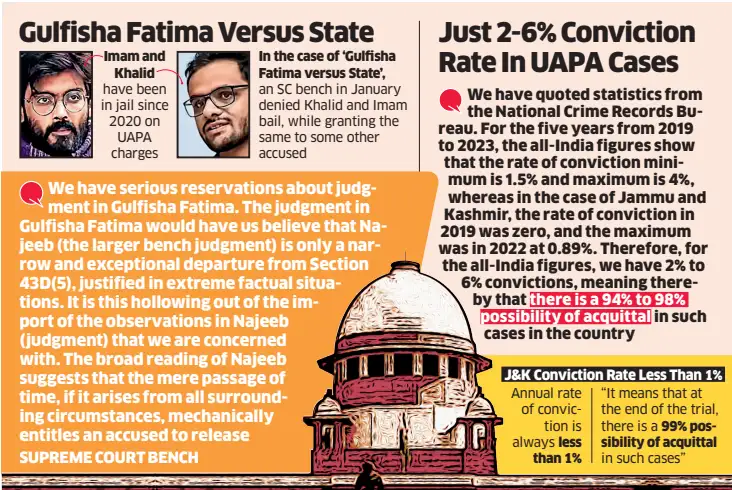
Both Khalid and Imam have been in jail since 2020 on UAPA charges. In the case of ‘Gulfisha Fatima versus State’, another bench of the court in January 2026 denied Khalid and Imam bail, while granting the same to some other accused in the case. The bench had ruled that Khalid and Imam’s case stood on “qualitatively different footing as compared to other accused”.
 ET Bureau
On Monday, the bench of justices Nagarathna and Bhuyan, however, observed that the Gulfisha Fatima ruling diluted a larger, three-judge bench judgment in which the larger bench had ruled that the right to speedy trial under Article 21 of the Constitution would apply to even UAPA accused, and ruled that such persons cannot indefinitely be kept in jail as undertrial prisoners.
“We have serious reservations about judgment in Gulfisha Fatima. The judgment in Gulfisha Fatima would have us believe that Najeeb (the larger bench judgment) is only a narrow and exceptional departure from Section 43D(5), justified in extreme factual situations. It is this hollowing out of the import of the observations in Najeeb (judgment) that we are concerned with. The broad reading of Najeeb suggests that the mere passage of time, if it arises from all surrounding circumstances, mechanically entitles an accused to release,” the court said.
The bench said that “…therefore, we have no manner of doubt in stating that even under UAPA, bail is the rule and jail is the exception. Of course, in an appropriate case, bail can be denied having regard to the facts of that particular case”.
In the same judgment, SC took a grim view of the abysmally low conviction rate in cases registered under UAPA. The bench observed that over 90% of such trials end in acquittals.
The bench headed by justice Nagarathna referred to official crime statistics to note that the pan-India conviction rate in UAPA cases between 2019 and 2023 was 2-6%, meaning there was a 94-98% chance that a UAPA accused would be acquitted at the end of his trial.
“We have quoted statistics from the National Crime Records Bureau (NCRB). For the five years from 2019 to 2023, the all-India figures show that the rate of conviction minimum is 1.5% and the maximum is 4%, whereas in the case of Jammu and Kashmir, the rate of conviction in 2019 was zero, and the maximum was in 2022 at 0.89%. Therefore, for the all-India figures, we have 2% to 6% convictions, meaning thereby that there is a 94% to 98% possibility of acquittal in such cases in the country,” the bench said.
As regards Jammu and Kashmir, the bench said, the annual rate of conviction is always less than 1%. “It means that at the end of the trial, there is a 99% possibility of acquittal in such cases,” the bench observed.