Synopsis
Airlines are experiencing weak forward bookings and muted growth plans due to high airfares and a weaker rupee, following a call to postpone foreign travel. While large-scale cancellations haven’t occurred, the focus is shifting towards boosting domestic tourism and its economic benefits.
 Reuters
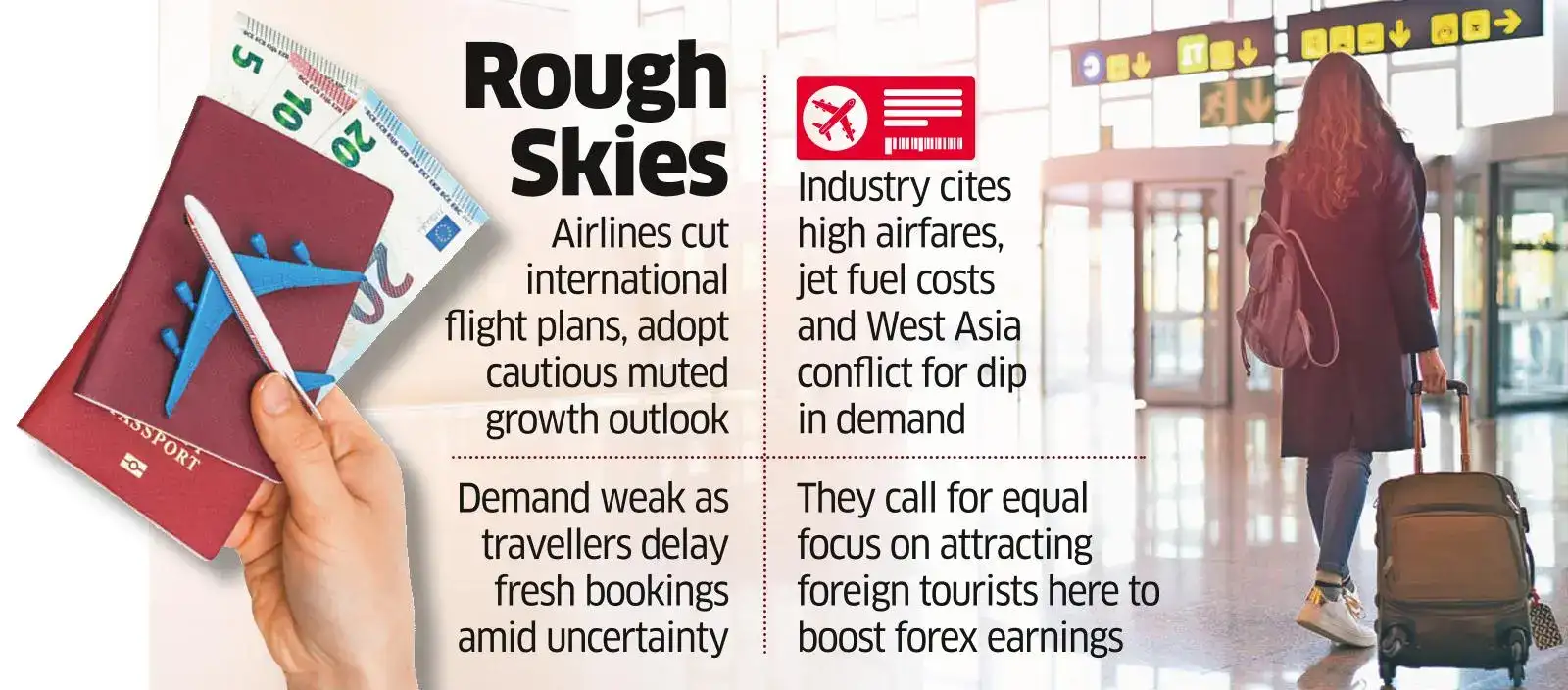
New Delhi: Airlines haven’t yet faced large scale ticket cancellations since Prime Minister Narendra Modi’s call to avoid overseas travel. However, forward bookings remain under pressure due to a sharp increase in airfares along with a weaker rupee, which has increased the cost of travel.
“There are no reports of any large-scale cancellations, but sentiments are very down due to the prevailing conditions,” said an airline official. “Forward bookings are showing a weak pattern.”
Airlines see no major cancellations after call to cut foreign travel, though outlook remains weak
Modi on Sunday appealed to citizens to postpone foreign travel for a year and instead prioritise domestic travel to support the local economy. This is among several austerity measures the PM proposed as the Indian economy battles the consequences of the simmering West Asia crisis.
Airlines, on their part, are cautious, making plans for muted growth with cuts to international services. Air India has reduced frequency to multiple European and North American cities due to high jet fuel prices.
“We are not even recovering the operating cost in many international flights,” the official said. “Increasing ticket prices beyond a point remain unsustainable as it hits demand. Right now, people who had booked before the Gulf crisis are travelling. There is very little fresh booking.”
Industry bodies and travel companies cite the steep rise in international airfares fuelled by higher jet fuel prices and the uncertainty around the conflict in West Asia as main factors impacting international travel demand. They however expect an uptick in domestic air travel as some travellers reconsider overseas plans.
“For the travel industry, this moment is not necessarily about a decline in overall travel demand, but rather a redistribution of demand from outbound tourism to domestic exploration,” said Govind Gaur, founder and CEO, WanderOn, a travel firm. “We are already seeing increased demand for premium domestic vacations, experiential group travel, road trips, adventure travel, and destination celebrations within India.”
Rajiv Mehra, general secretary, The Federation of Associations in Indian Tourism and Hospitality (FAITH), said while saving foreign exchange by reducing outbound travel is understandable, equal focus must be placed on earning foreign exchange by attracting more international tourists to India.
KB Kachru, president, Hotel Association of India (HAI) and chairman, South Asia at Radisson Hotel Group said India’s domestic travel market has emerged as one of the strongest demand engines globally, driving hospitality growth, employment generation and infrastructure utilisation across metros as well as Tier 2 and 3 destinations.
“In the current volatile geopolitical environment, stronger domestic tourism also contributes towards conserving foreign exchange while building a more resilient and self-reliant travel ecosystem,” said Kachru.
Rajiv Mehra, general secretary, The Federation of Associations in Indian Tourism and Hospitality (FAITH), said while saving foreign exchange by reducing outbound travel is understandable, equal focus must be placed on earning foreign exchange by attracting more international tourists to India.
“This requires easing visa restrictions, improving connectivity, and significantly strengthening India’s tourism promotion abroad,” he said. “It is unfortunate that a country blessed with immense natural beauty, cultural richness, spirituality and world-class historical monuments attracts only around two crore foreign tourists annually.”
While outbound travel from India has grown by more than 14% since the pandemic, India is yet to reach the pre-pandemic level of foreign tourist arrivals (FTAs), according to tourism ministry data.