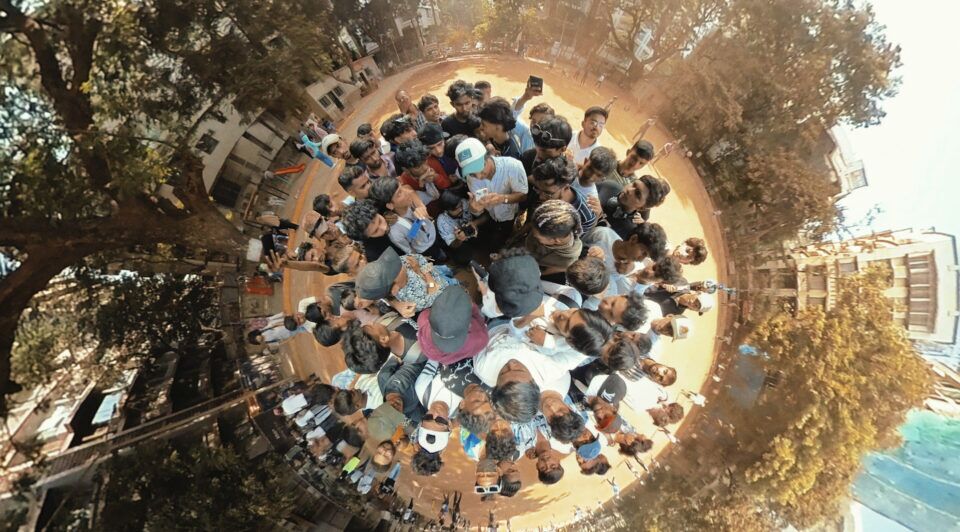
Inside an underground Mumbai cypher, where delivery workers, laborers, milkmen and students step into the circle and make space for themselves in hip-hop.
The Rose That Grew From Concrete – By Tupac Shakur
Did you hear about the rose that grew
from a crack in the concrete?
Proving nature’s law is wrong
It learned to walk without having feet.
Funny it seems, but by keeping its dreams,
it learned to breathe fresh air.
Long live the rose that grew from concrete
when no one else ever cared.
Two years ago, I came across a video from a cypher on my Instagram feed featuring a face I had never seen before. There were a dozen-odd people around him, completely hyped, and a guy in a white shirt stepped up, picked up a beat, and started spitting, “Sameer gaane nahi likhta, woh likhta facts hai.” A few bars later came another one: “Mujhe parvah hi nahi hui kabhi snatching ki, maa ke gale mein kabhi sona hi nahi tha.” Every bar seemed to land like something you could screenshot and keep for later. I remember thinking this was probably the first time in years I had heard a completely new face, and immediately felt he could become the next big thing. The last time I remember having that feeling was when I first heard Divine’s early track “Farak.”
The video was uploaded by a page called Vile Parle Cypher, a group of young people from the Mumbai suburb who had built a space around their love for hip-hop. What I didn’t immediately register was who was stepping into that circle: delivery boys, security guards, milkmen, laborers and others leaving their everyday jobs behind for a few minutes to rap, listen and be part of the scene.
Then Sameer Shaikh’s video went viral, and suddenly the cypher was everywhere.

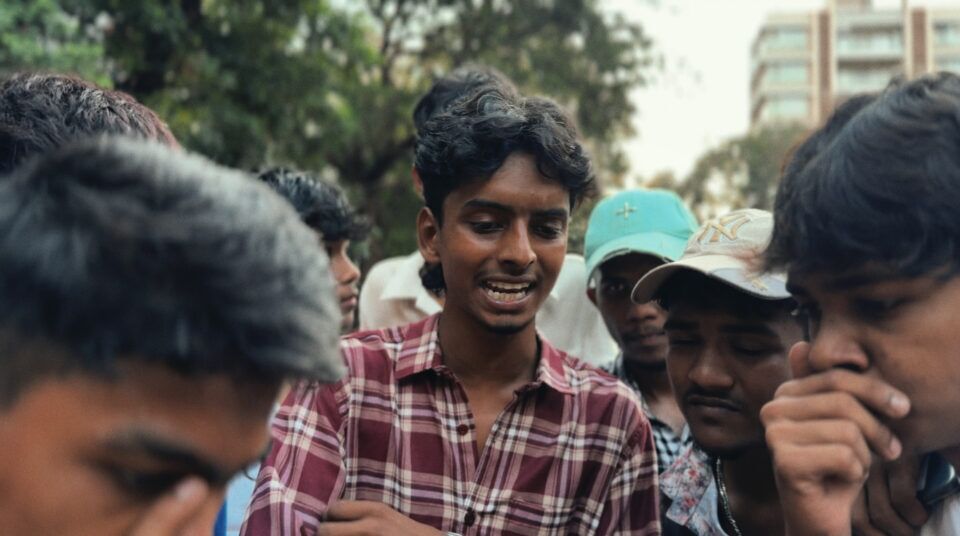
The Circle Was Already There
Cyphers have long been an inseparable part of hip-hop culture, creating space for spontaneity, self-expression and opportunity at the grassroots level, where anyone can step up and make their voice heard.
In his documentary Unreleased, streaming on storytelling platform STRT91, filmmaker Imran Shamsi zooms in on the group of rappers who regularly gather in the Mumbai suburb of Vile Parle, examining what happens when people create their own little ecosystem around hip-hop without waiting for the music industry to invite them in.
Though Shamsi initially went to shoot a 90-second reel, he quickly realized he was stepping into something bigger. People had been showing up every Saturday and building a space that didn’t need an outsider to give it shape. “We weren’t creating the moment by putting a camera there,” Shamsi tells Rolling Stone India. “We were stepping into something that already had its own rhythm.”
That rhythm was built by Kuldeep Jaswant Singh Chandaliya, the 22-year-old founder of the Vile Parle Cypher. Kuldeep, who goes by the stage name Deep/Psy, comes from outside the conventional image of a full-time musician: he works in the Merchant Navy and started rapping without the kind of infrastructure that is now increasingly associated with making it as an artist. There was no expensive studio, big production budget, or marketing machinery behind him. What existed first was the desire to write, perform, and find other people who wanted to do the same. The cypher grew from that basic need to express himself, eventually becoming a regular place where people could turn up without having to explain their credentials.
That is perhaps the first thing a cypher strips away: the need to prove that you belong there. “You can be a delivery guy, you can be a student, you can be working some completely odd jobs and still come here and call yourself a rapper,” Kuldeep explains.
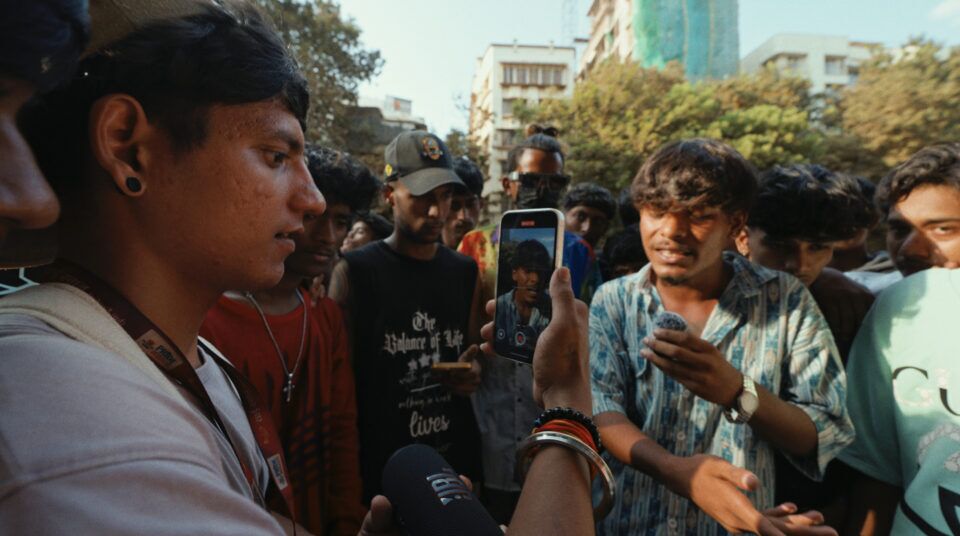
In most versions of the music industry, there are a hundred things that can come before the actual music: your numbers, your image, your connections, your production quality, and whether someone important has cosigned you. None of those things are irrelevant if an artist wants to build a career, but they can make the starting line feel much further away than it needs to be. A cypher, instead, brings the starting point back to something much simpler: a beat, a voice, and an audience.
There is a line by Kuldeep in Unreleased that captures that idea almost perfectly: “Expensive paints doesn’t make a good painting, and expensive pen doesn’t make good writing.”
What Happens Inside the Circle
What makes the Vile Parle Cypher particularly interesting is the variety of lives that enter it. The people showing up aren’t necessarily spending their days thinking about music. Some work as security guards, some deliver milk or groceries, some study, and some have entirely different careers. They finish whatever the day has asked of them and then come here to rap. In fact, they are not even all from Vile Parle but from different parts of Mumbai, proudly repping their pincodes. It would be easy to package that as a familiar story about struggling artists overcoming difficult circumstances, but that would miss something more interesting: their jobs are not necessarily the reason they create. They are simply part of the lives they are creating from.
“Look at Mastaan,” Shamsi says. “He’s delivering milk at 4 AM, and then he’s writing. Ayan started working at 12. These guys aren’t sitting around thinking, ‘I want to become a rapper, what should I write about?’ Their struggle isn’t just a theme; it’s their main source of material.”
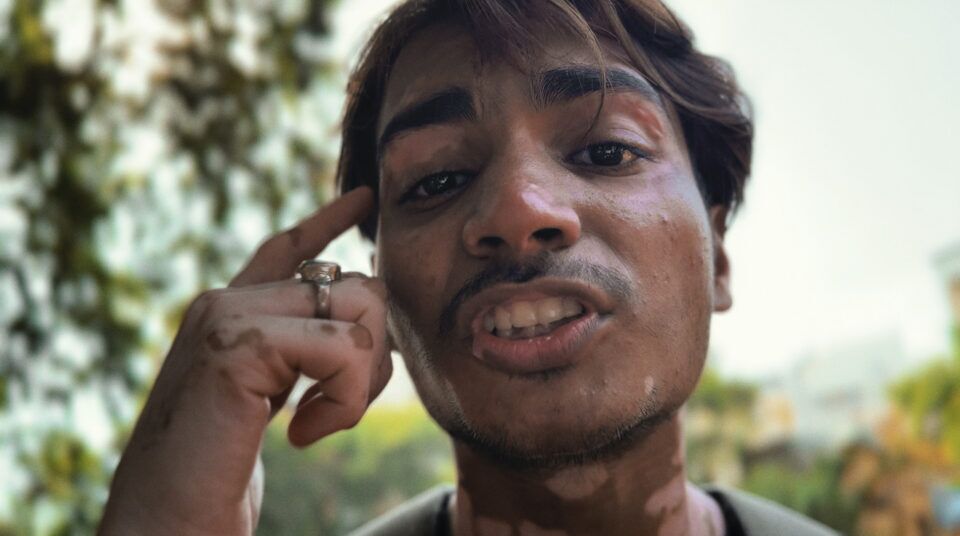
The stories behind the cypher are as varied as the voices inside it. Mohammad Anas, aka Lil Axe, works as a picker-packer at Blinkit from 7 AM to 4 PM before heading to the cypher. Yama Raaz, a chef from Nepal, writes whenever he finds the time. Nikhil Joshi, aka Kotilya, raps in Marwadi, bringing his roots into the circle, while David, aka Zeng Saikia, joins for the first time, rapping in Assamese and drawing curious uncles out of the park to see what’s happening. Then there’s Manali from Chembur, who had to spend a week convincing her dad to let her go for the cypher before he finally gave in, joined along and ended up loving the experience.
The cypher doesn’t seem to ask people to leave those parts of themselves at the door. They become part of what the circle sounds like.
That distinction was particularly important for Shamsi when he began documenting this community. “You can very easily take somebody’s struggle, shoot it beautifully, put music under it and suddenly you’ve turned their life into content,” he points out. “They don’t need sympathy. They need an audience.”
The audience is one of the most important things the cypher really offers. Outside the circle, people are constantly being reduced to whatever role they occupy, whether that’s their profession, neighborhood, religion or background. Inside the cypher, those labels temporarily lose some of their weight. “Inside the circle, they’re just people with something to say,” Shamsi explains. The inequalities of the outside world don’t magically disappear when somebody picks up a microphone, but for those few minutes the usual question of who gets to speak and who is expected to listen can be rearranged.
Kuldeep has seen this happen with the people who show up with a lot more than a few verses. He talks about Pannu, a young woman surrounded largely by boys in the cypher, and how having a space where people listen to her helped her find confidence. “For a lot of people, nobody really listens to them,” he says. “They go to work, come back, they have their own problems, and life just keeps moving. Then they come here and for those few minutes, everyone is listening.” The cypher therefore becomes a place where somebody can discover that their voice has an audience before they have any idea what to do with that audience.
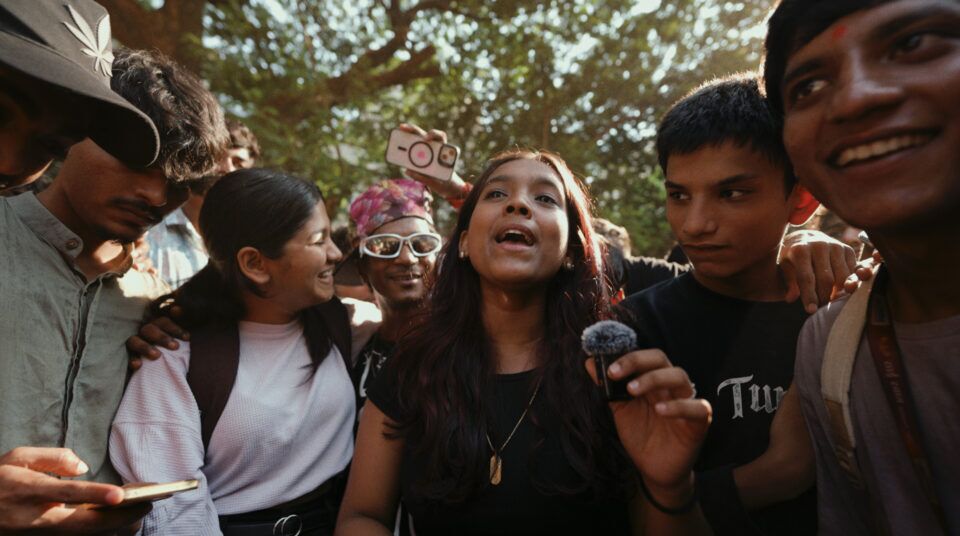
It also gives people something that a polished studio recording can never: the actual freedom to be bad in public. A song uploaded on a streaming platform usually comes after decisions have already been made about what stays and what gets removed. A cypher is much less forgiving and, because of that, much more useful. You can mess up, write something that doesn’t land, learn from it, and come back the following week. “You learn only after you fail,” Kuldeep says. “Cypher is exactly like life, you can fail here and get back up, because there’s always another round.” For someone learning how to perform, that repeated opportunity may be more valuable than one perfect recording.
When the Circle Spills Onto the Internet
19-year-old Sameer’s story is where the private world of the cypher suddenly breaks out of its circle. His viral video began like any other cypher performance, but the internet decided it had to be more. “Jab meri Reel viral hui thi tab toh main bilkul hi ready nahi tha (When my Reel went viral, I wasn’t ready for it at all),” he says. He had simply come to perform. The video took on a life of its own.
Before that happened, Sameer says he was just making music for himself, taking the things he experienced and turning them into bars that other people might relate to or quote later. But with the viral moment came a different kind of responsibility. “Pehle main sirf apne liye rap karta tha, par ab I do it for me and my people.”
That transition is revealing because the cypher doesn’t promise that it will lead anywhere. Most people can perform in a cypher every week and still return to the same life the next morning. But the chance of being noticed exists because the performances are being documented and shared socially.
Many of the desi hip-hop scene’s biggest names began their journeys through cyphers: Seedhe Maut’s Calm and Encore ABJ met through Delhi’s Spit Dope scene, while Mumbai’s cyphers helped shape the ecosystem around artists like Divine, Naezy and MC Altaf. More recently, Punjabi rapper Param’s freestyle videos from Moga’s Dana Mandi helped put her on the map before her breakout hit “That Girl” exploded on the scene, while a cypher freestyle by Navi Mumbai rapper Rare 78 went so viral, it got a co-sign from Cardi B. Cyphers have long been the starting point for some of Indian hip-hop defining moments, including the friction, between MC Stan and Emiway.
This makes the cypher an especially important space for artists who are still figuring out where they fit in hip-hop. Kuldeep believes there are people with genuine talent who simply never come across the right opportunity to develop or perform. “This is society’s loss,” he says. “The talent sitting right under their nose can get famous 1000 kms away and they will still have no idea.” Meanwhile, for Shamsi, the question of who gets noticed is separate from the question of who gets to be an artist.
“You do not become an artist when the industry declares you successful, ” Shamsi says. “You become an artist the instant you cannot stop creating.”
It’s impossible to know how many potential artists disappear because they never find a place like this, but the Vile Parle Cypher makes one thing clear: talent and opportunity do not always show up together.